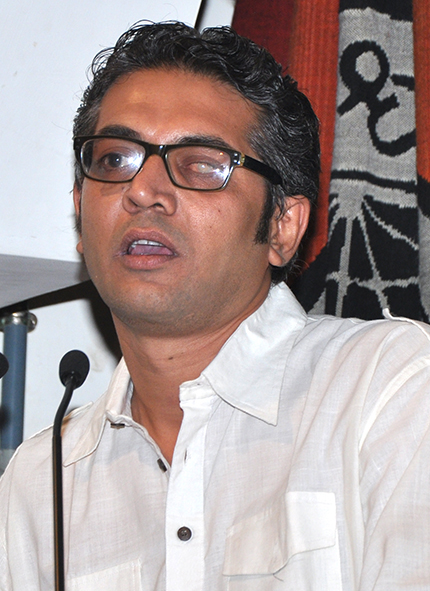
Saumya Joshi is not a screenwriter who occasionally does theatre. He is a theatre writer whose sentences keep escaping into cinema, and the escape rate is extraordinary. Two film credits, both of them consequential: he wrote the Hindi film 102 Not Out from his own Gujarati play, and he wrote the dialogues and every song lyric in Hellaro. Everything that makes those two credits work was built somewhere else first, in front of paying audiences in Ahmedabad, with no second take available.
The arc
01The professor with a second life
Joshi finished his BA at H. K. Arts College in Ahmedabad in 1993 and his MA at Gujarat University in 1995, and then walked straight back into his own college as a professor of English literature. He held that post for sixteen years.
The plays were being written the whole time. He founded Fade-In Theatre in 2010 with a group of younger theatre people and finally resigned the teaching job in September 2011, at thirty eight, which is a strange age to bet on a Gujarati stage career and the strongest evidence available that he was not bluffing.
02The play about the year nobody wanted to stage
He had debuted with Rami Lo Ne Yaar!, but the play that fixed his name was Dost Chokkas Ahin Ek Nagar Vastu Hatu, a musical black comedy built on the 2002 Gujarat riots. Writing a comedy about that, in Gujarati, in Gujarat, within a few years of it happening, is a decision most writers would have talked themselves out of. The Week put him on its list of fifty rising stars of India in 2003.
Aathma Taaru Nu Aakash followed and became the first play from Gujarat selected for the Prithvi Theatre Festival in Mumbai, in 2005. That is a border crossing that Gujarati theatre had been trying to make for decades, and it happened on a script by a working college lecturer.
03One book, and then silence
Greenroomma came out in 2008 and it remains the only collection of poems he has published. Eighteen years later there is still no second book.
What is in it explains the restraint. The people in those poems do not have a stage: a sex worker, a boy working the Sivakasi fireworks factory, a labourer taking shade under the sack he carries. Joshi writes across ghazal, nazm, geet and free verse without settling into any of them, which is a poet's way of saying the form should follow the person, not the other way round. One book that people still quote beats six that nobody does.
04Two credits, both landmarks
102 Not Out started as his Gujarati play about a 102 year old man determined to outlive a record. Umesh Shukla filmed it in Hindi in 2018 with Amitabh Bachchan and Rishi Kapoor playing father and son for the first time, and Joshi is credited as the writer. It reported a worldwide gross of about Rs 115.3 crore.
Hellaro is the other one. Joshi wrote the dialogues and all four song lyrics, with Mehul Surti composing. The film won the National Film Award for Best Feature Film at the 66th National Film Awards, the only Gujarati film ever to take the top prize, on a reported budget of around Rs 2.5 crore. A poet who had spent two decades writing for people who are not allowed to speak got handed a film about women in the Rann of Kutch who are not allowed to dance. The casting of the writer was the smartest decision the production made.
The work that matters
Pick it not because it won, but because of what he was asked to do. In a film whose entire premise is women dancing, the songs are not decoration laid over the plot, they are the plot's other half. All four are his, and the score they sit inside runs eighteen minutes and forty four seconds in total. That is a very small amount of music to carry a National Award winning film, which means every line had to work.
The play, not a film, and still the most important thing he has written. A musical black comedy set against the 2002 riots is the kind of script that ends careers when it is done badly. It got him named among The Week's fifty rising stars of India instead, and every commission he has had since traces back to it.
The proof that a Gujarati stage script can travel without being diluted. It went to Hindi, to Amitabh Bachchan and Rishi Kapoor, and to a reported Rs 115 crore, and the writing credit stayed with the man who wrote the original play rather than being handed to a Bombay adapter.
Verified credits
| Year | Work | Form | Credit |
|---|---|---|---|
| 2003 | Dost Chokkas Ahin Ek Nagar Vastu Hatu | Gujarati play | Writer; The Week named him a rising star of India that year |
| 2005 | Aathma Taaru Nu Aakash | Gujarati play | Writer; first play from Gujarat at the Prithvi Theatre Festival |
| 2008 | Greenroomma | Poetry collection | Poet; his only book of poems |
| 2018 | 102 Not Out | Hindi film | Writer, adapted from his own play |
| 2019 | Hellaro | Gujarati film | Dialogues and lyrics for all four songs |
Questions people ask
Did Saumya Joshi write the film 102 Not Out or only the play?
Both, in effect. The 2018 Hindi film is adapted from his Gujarati play and he is credited as the film's writer, with Umesh Shukla directing.
What did he write on Hellaro?
Dialogues and lyrics. The screenplay is credited to Abhishek Shah and Prateek Gupta, with Joshi credited for the dialogues and the songs. All four tracks on the Mehul Surti soundtrack carry his lyrics.
How many books has he published?
One collection of poems, Greenroomma, in 2008. His body of work is overwhelmingly in plays, which are performed rather than published, which is why his page count understates him so badly.
What awards has he won?
The Chandravadan Chimanlal Mehta Award in 2013 for his contribution to Gujarati theatre, the Yuva Gaurav Puraskar in 2007, the Takhtasinh Parmar Prize for 2008-09, the Sadbhavna Award in 2014, and the Ravji Patel Award and Balvantray Thakor Prize.
Is he a poet or a playwright first?
Playwright by volume and by reputation, poet by instinct. He started writing poems at eighteen and his first was published in Kavilok, but the plays are what fill halls in Ahmedabad and Mumbai.
Sources
Career facts verified against published biographies and an IMDb-sourced Gujarati credits database. Photographs are free-licensed Wikimedia Commons files, reused with the attribution each licence requires. Nothing on this page is estimated.
- English Wikipedia, Saumya Joshi, biography, works and recognition sections, retrieved July 2026
- English Wikipedia, Hellaro, infobox credits and soundtrack track listing, retrieved July 2026
- English Wikipedia, 102 Not Out, infobox credits and reported box office, retrieved July 2026
- Wikimedia Commons imageinfo API for the photograph licence and photographer, checked July 2026