English Wikipedia's Gujarati language article lists roughly two dozen named varieties of Gujarati, grouped chiefly into Standard Gujarati, Amdawadi Gujarati, which includes the Surati, Charotari, Patidari and Vadodari varieties, and Kathiawari, which includes Bhavnagari, Gohilwadi, Halari, Jhalawadi and Sorathi, alongside the distinct Parsi variety and the Arabic influenced Lisan ud-Dawat of the Bohra community. Gujarati cinema uses perhaps four of them with any regularity. Kutchi, despite the name of the region, is classified by most linguists as a dialect of Sindhi rather than of Gujarati, and a Kutchmitra reviewer criticised Hellaro precisely for the absence of Kutchi in a film set in Kutch. The comic register of Gujarati cinema descends from Bhavai, the fourteenth century folk theatre form credited to Asaita Thakar, whose own stage language Wikipedia describes as a blend of Hindi, Urdu and Marwari.
Ask what a Gujarati film sounds like and you will get an answer about music. That is the wrong organ. What a Gujarati film sounds like is a question about which Gujarati it is speaking, because the language is not one thing. It is a spread of named varieties across a small state, and a listener from Rajkot can place a speaker from Nadiad in a sentence and a half. Films choose one of those varieties every time they open a mouth, and the choice is a commercial decision disguised as a creative one.
This page maps what can actually be sourced. The dialect classification comes from the linguistic record, not from film publicity. The Bhavai material comes from the documented history of the form, including the parts that are inconvenient, such as its stage language being a blend of Hindi, Urdu and Marwari rather than pure Gujarati. Where an entry describes a convention rather than a documented fact, it says so in the sentence. That distinction is the whole discipline here, because dialect writing is the subject on which Indian film journalism is loosest and confident nonsense travels furthest.
The list at a glance
| Entry | What it is | The sourced anchor | Where it shows up |
|---|---|---|---|
| Amdawadi Gujarati | The dialect group covering Ahmedabad and its region | Listed with ten named varieties including Surati, Charotari, Patidari and Vadodari | Chhello Divas, set among Ahmedabad college students |
| Kathiawari | The Kathiawar peninsula group, with significant Sindhi influence | Five named varieties: Bhavnagari, Gohilwadi, Halari, Jhalawadi, Sorathi | Last Film Show, shot in Saurashtra with six local village boys cast |
| Surati | The speech of Surat and Bharuch | Classified as a variety within the Amdawadi Gujarati group | Surat trained performers, including Pratik Gandhi |
| Kutchi | A dialect of Sindhi, not of Gujarati | Kutchmitra criticised Hellaro for the absence of Kutchi in a film set in Kutch | Hellaro, set in the Rann of Kutch in the 1970s |
| Mumbai Gujarati | The Gujarati of the Mumbai commercial stage | Listed as a variety of Standard Gujarati | Over a hundred Gujarati plays produced by Sanjay Goradia |
| Bhavai | Fourteenth century folk theatre form of Gujarat | Credited to Asaita Thakar, roughly 60 of a reported 360 veshas survive | The comic grammar underneath Gujarati screen comedy |
| Bhavni Bhavai | Ketan Mehta's 1980 debut | Not a Bhavai performance, but incorporates several elements of the form | The only major film named for Bhavai |
| The Gujjubhai stage voice | A comic register built over 12,000 live performances | Siddharth Randeria holds the record for most live performances by an actor | Gujjubhai the Great, 2015, and its sequel |
| Kasoombo | A period war film register | TV9 Gujarati and Mid-Day Gujarati both singled out the dialogues | Set during Alauddin Khilji's invasion of Gujarat |
| Vash | Horror built on the spoken command | The climax turns on deafening a victim and severing a voice | Best Gujarati Feature Film at the 71st National Film Awards |
| The Hindi dub | The industry's second language strategy | Kasoombo, Vash Level 2 and Laalo all released Hindi versions | 2024 to 2026 |
| Saumya Joshi | Playwright and poet who writes film dialogue | Wrote lyrics, additional screenplay and dialogues for Hellaro | Hellaro, 102 Not Out |
| Niren Bhatt | Dialogue and lyric writer turned Hindi blockbuster writer | Three Gujarati features, then Stree 2 | Bey Yaar, Wrong Side Raju, Ventilator |
| Raam Mori | Short story writer whose prose is rural Saurashtra | Sahitya Akademi Yuva Puraskar, 2017 | 21mu Tiffin, Kutch Express, Kasoombo |
How this list was built
Every dialect claim on this page is traced to the classification set out in English Wikipedia's Gujarati language article, which itself follows the Linguistic Survey of India and cites William Tisdall's early tripartite scheme, and to the separate Kutchi language and Gujarati theatre articles. Where the linguistic record and popular usage disagree, the record wins and the disagreement is stated: Kutchi is popularly treated as a Gujarati dialect and is classified by most linguists as a dialect of Sindhi, and the Saurashtra language of southern India is a separate thing from the Kathiawari varieties spoken in Saurashtra today. Film facts come from English Wikipedia film and biography articles and the sources they cite, chiefly The Times of India, Mid-Day Gujarati, TV9 Gujarati and Kutchmitra. The hardest rule applied here: this page never asserts that a specific film is spoken in a specific dialect unless a source says so. What it does instead is state the sourced facts about setting, casting and reception, then label the reading as a reading. Three things are named rather than smoothed over. First, no Gujarati film on record has been made in Parsi Gujarati or in Lisan ud-Dawat, the two most linguistically distinctive varieties, and neither variety has an entry here because no verified associated person could be attached to one under the site's photo rule; the Parsi contribution appears instead through Gujarati theatre, which Wikipedia dates to Rustam Sohrab, performed by the Parsee Natak Mandali in Mumbai on 29 October 1853. Second, the etymology of the title Kasoombo, which dictionaries including Wiktionary trace to the Sanskrit kusumbha meaning safflower and which Gujarati readers associate with Zaverchand Meghani's poem Lagyo Kasumbi no Rang, is given as etymology only, because the film's own article does not explain its title. Third, claims that Chhello Divas is written in Amdavadi slang are ubiquitous in reviews and user commentary and are not stated by an authoritative source, so this page reports what is documented, that the film is about Ahmedabad college students and was shot in Ahmedabad and Vadodara, and marks the slang reading as a reading. Entries ship only with a free licensed Wikimedia Commons photograph of a verified associated person, named in the alt text, or a scrape verified Instagram account checked on 29 July 2026.
The dialect map, and the four varieties the screen actually uses
Roughly two dozen named varieties exist. Gujarati cinema speaks about four of them.
1Amdawadi Gujarati

Amdawadi Gujarati is the largest group in the classification, and its listed varieties run from Ahmedabad Gamadia through Charotari and Patidari to Surati and Vadodari. That breadth is why the industry treats it as the default. A film written in Amdawadi Gujarati is not making a regional statement, it is speaking the language of the city where the studios, the film schools, the advertising agencies and most of the audience sit. It is the closest Gujarati cinema has to an unmarked register.
Chhello Divas is the standard example and it deserves to be stated carefully. What is documented is that Krishnadev Yagnik's film follows eight Ahmedabad college students, was shot in Ahmedabad and Vadodara including at Shanti Business School and the Sabarmati Riverfront, opened on a reported 231 screens worldwide and grossed a reported 18 crore rupees. The claim that the film runs on Amdavadi college slang is a reading, repeated by reviewers and by every viewer who quotes it back, rather than a sourced linguistic fact. The reading is almost certainly right, and it is still a reading, and the difference is worth holding onto on a page like this.
Photo: Snehrashmi, CC BY-SA 4.0, via Wikimedia Commons.
2Kathiawari

Kathiawari is the variety group that carries the most cultural weight and the least urban power. It is spoken across the peninsula, it splits into Bhavnagari, Gohilwadi, Halari, Jhalawadi and Sorathi, and the record notes significant Sindhi influence, which makes geographic sense once you look at the sea between Kutch, Kathiawar and Sindh. It is the register of folk poetry, of Meghani's ballads, of the village that the city left. On screen it signals rootedness the way a Yorkshire accent does in British film, which is to say it is trusted and patronised in roughly equal measure.
Last Film Show is the cleanest documented case of a production reaching for that sound rather than approximating it. It is set in Chalala, a village in Saurashtra, Pan Nalin was born and raised in Adtala village in the same region, and six village boys from local communities were cast rather than trained child actors from Ahmedabad. That is a casting decision that determines the film's phonetics before a word of dialogue is written. One caution that catches people out: the Saurashtra language listed separately in the classification belongs to a community that migrated south to Tamil country in the Middle Ages, and it is not the Kathiawari spoken in Saurashtra today.
Photo: Benny Crude, CC BY-SA 4.0, via Wikimedia Commons.
3Surati

Surat gives Gujarati one of its most identifiable sounds and Gujarati cinema almost never uses it as the spine of a film. The classification places Surati inside the Amdawadi Gujarati group while also naming it separately, which is a fair reflection of an awkward reality: it is close enough to the standard to be legible everywhere and distinct enough to be flagged instantly. Within Gujarat, Surati speech carries a comic reputation, the way certain city accents do in every language. That reputation is folk consensus, not a linguistic finding, and it is written here as the former.
The city's real contribution to cinema has been performers rather than a register. Pratik Gandhi was born in Surat to two teachers, schooled there, and worked in theatre there before an engineering degree and eight years of corporate jobs took him to Mumbai and eventually to Bey Yaar, Wrong Side Raju and Scam 1992. Surat is also one of the industry's most important exhibition markets, which produces the odd result that the city buys a very large share of the tickets and hears its own speech on screen far less often than Ahmedabad does.
Photo: Desmond Herzfelder, CC BY 4.0, via Wikimedia Commons.
4Kutchi
Kutchi is the trap on this subject. It is spoken in a district of Gujarat, it is written in Gujarati script in practice, everybody calls it a Gujarati dialect, and most linguists classify it as a dialect of Sindhi. It sits in the same family neighbourhood as Memoni, which is related to Gujarati only distantly. Getting this wrong is not pedantry, it is the difference between a regional accent and a separate language with its own grammar, and it changes what a filmmaker is actually asking an actor to do.
Hellaro made the question concrete. Abhishek Shah's film is set in the Rann of Kutch in the 1970s and draws on the folklore of Vrajvani village, and it won the National Film Award for Best Feature Film. Ramesh Tanna, writing in Kutchmitra, praised the direction, acting and cinematography, called it a must watch, and criticised the absence of Kutchi in a film set in Kutch along with the depiction of local culture and of the decade. That is the sharpest published language criticism in modern Gujarati cinema and it comes from the region being portrayed. The film also drew a police complaint under the Atrocities Act over its use of the word Harijan in dialogue, which is the other lesson: the words a Gujarati film chooses have consequences outside the cinema.
Instagram: @abhishek_humanbeing (verified 2026-07-29).
5Mumbai Gujarati

Gujarati theatre has been a Mumbai business since 1853, when the Parsee Natak Mandali staged Rustam Sohrab on 29 October and started the tradition. The classification records Mumbai Gujarati as a variety of Standard Gujarati and the Linguistic Survey of India names Bombay separately, which is the linguists agreeing with the box office. Sanjay Goradia alone has produced more than a hundred Gujarati plays and acted in roughly a quarter of them, on top of Hindi productions and Gujarati television for Colors Gujarati.
Here is the consequence, offered as a reading rather than a finding. The commercial Gujarati stage is written, rehearsed and sold in Mumbai for an audience of Gujaratis who have lived outside Gujarat for generations, and film after film is drawn from that pipeline, whether as an adapted play or as a cast trained on it. So the comic Gujarati that reaches the screen is often a Mumbai product wearing Ahmedabad clothes. It is faster, it is more Hindi inflected, and it is built for a proscenium arch where the back row has to hear the punchline. That is not a criticism. It is why the jokes land.
Photo: Nizil Shah, CC BY-SA 4.0, via Wikimedia Commons.
Bhavai, the root under the comedy
Every convention Gujarati screen comedy uses was working in a temple courtyard six hundred years earlier.
6Bhavai

Bhavai is the load bearing wall. It is credited to Asaita Thakar in the fourteenth century, one of his compositions is dated 1360, and about sixty of a reported three hundred and sixty veshas survive. The troupe chief, the Nayak, marks the arena, offers kumkum to the lamp that stands for Amba, and sings to her. Ganesha enters with his face behind a plate, then Kali, then the Brahmana, and only then does the play begin. The Nayak and the jester stay on stage throughout, commenting on the action and interrupting it. Women's parts are played by men. A four foot copper bhungal announces the important characters.
Two things in that description explain modern Gujarati comedy better than anything written since. First, the running commentary. A Gujarati comic scene that keeps breaking to address the audience, that lets a character stand outside the plot and mock it, is doing what the Nayak and the jester did in the temple courtyard. Second, the target. Wikipedia records that subtle social criticism laced with pungent humour is Bhavai's speciality, and that the pompous behaviour of high caste people is what gets scoffed at, probably because of the injustice done to Asaita Thakar himself, who was outcast for dining with a girl he saved by claiming her as his daughter. The inconvenient detail, and the one nobody quotes, is that the stage language of Bhavai is described as a blend of Hindi, Urdu and Marwari. The root of Gujarati comedy was never linguistically pure to begin with.
Photo: Bollywood Hungama, CC BY 3.0, via Wikimedia Commons.
7Bhavni Bhavai

Ketan Mehta's debut is the only major Gujarati film that puts the word Bhavai in its title, and the industry's own encyclopedia entry is careful to say it is not a Bhavai performance, it incorporates several elements of the form. That distinction is the interesting part. Mehta took the frame, the direct address, the troupe telling a story about caste to an audience that includes the people being mocked, and used it to make a film about untouchability, with Naseeruddin Shah, Om Puri and Smita Patil in the cast and a district bank in Ahmedabad among the financiers.
The film travelled on that structure. It was selected for a festival at the Museum of Modern Art, took the UNESCO Club Human Rights award at the Three Continents Festival, and won the Nargis Dutt Award for Best Feature Film on National Integration along with Best Art Direction for Meera Lakhia at the 28th National Film Awards. Since 1980 the commercial Gujarati industry has borrowed Bhavai's jokes and left its politics on the shelf. Bhavni Bhavai is the one film that took the politics and let the jokes carry them.
Photo: Ifpofficial, CC BY-SA 4.0, via Wikimedia Commons.
8The Gujjubhai stage voice

Twelve thousand live performances is not a career statistic, it is a laboratory result. Siddharth Randeria has been on the Gujarati stage since 1970, the Gujjubhai series began in 2002 with Gujjubhai E Gaam Gajaavyu, and Lage Raho Gujjubhai alone completed 800 shows in three years around the world. Every line in that repertoire has been tested against a live audience hundreds of times, kept if it worked, cut if it did not. What survives that process is not writing any more, it is engineering.
In 2015 the whole apparatus moved to film with Gujjubhai the Great, and the sequel followed in 2018. That is the pipeline this page keeps returning to: a comic Gujarati refined on stage in Mumbai and Ahmedabad, then poured into a camera. The value transfers because the register is already load tested. What it costs is regional specificity, since a voice tuned to please a hall in Mumbai, London and New Jersey cannot afford to be too local, which is the trade that dialect writing always faces and rarely names out loud.
Photo: Nizil Shah, CC BY-SA 4.0, via Wikimedia Commons.
Three registers modern Gujarati films built
A period film, a horror film and a dubbing decision, each of which is a language problem before it is anything else.
9Kasoombo

A period film is a language problem before it is a costume problem. Kasoombo is set during Alauddin Khilji's invasion of Gujarat, adapted from Vimalkumar Dhami's novel Amar Balidan, and it follows Dadu Barot, a village chief who leads a small band of warriors. There is no recording of how anyone spoke in that century, so the film has to invent a register that reads as old without becoming unplayable, which is the hardest single job in Indian screenwriting and the one that gets least credit.
Two Gujarati language reviewers named the dialogues specifically, Meena Kansagara of TV9 Gujarati and Rachana Joshi of Mid-Day Gujarati, which is unusual enough to be worth recording. The title carries its own linguistic weight: kasumbo comes from the Sanskrit word for safflower, the dye whose colour cannot be overdyed by any other, and Gujarati readers hear Zaverchand Meghani's Lagyo Kasumbi no Rang behind it. That association is offered here as etymology and literary context. The film's own article does not explain the title, so this page does not put an intention in the filmmaker's mouth.
Photo: Imfarhad7, CC BY-SA 4.0, via Wikimedia Commons.
10Vash

Of every film on this page, Vash is the one that is literally about language. A stranger takes control of a family's daughter through hypnotism and black magic, and the instrument of control is his voice. She obeys what he says. The escalation is verbal, the terror is verbal, and the resolution is surgical: the father deafens his own daughter with a pair of scissors so she cannot receive the commands, then cuts out the man's tongue, and the curse breaks. A film in which the ear and the tongue are the two organs the plot destroys.
That is not a coincidence of plotting, it is a horror engine assembled out of a culture in which the spoken word does work. Vows, curses, blessings and the promise given aloud all carry weight in the Gujarati stories this industry grew from, and Krishnadev Yagnik built a possession film in which the audience already believes that speech binds. It took Best Gujarati Feature Film at the 71st National Film Awards along with Best Actress in a Supporting Role for Janki Bodiwala, and its register, flat, domestic, ordinary family Gujarati under pressure, is the opposite of the theatrical comic voice that dominates the industry.
Photo: Bollywood Hungama, CC BY 3.0, via Wikimedia Commons.
11The Hindi dub

Within two years the industry ran three different experiments in the same direction. Kasoombo waited eleven weeks and then went Hindi across India on 3 May 2024. Vash Level 2 released both versions on the same day, 27 August 2025, with the Hindi one titled Vash Vivash Level 2. Laalo waited three months, then built a whole second campaign, Hindi poster on 22 December 2025, teaser on 23 December, trailer on 29 December, release on 9 January 2026. Three films, three strategies, one conclusion: Gujarati is no longer assumed to be the ceiling.
What a dub costs is the thing this page cares about. Everything on the dialect map above, the Kathiawari of a village elder, the Amdavadi of a college corridor, the Surati music in a comic aside, is flattened into a single neutral Hindi in the process. The plot survives, the jokes mostly survive, and the geography does not. Monal Gajjar has worked in Gujarati, Telugu, Tamil and Hindi and appears in both Kasoombo and Vash Level 2, which puts her on both sides of that trade in the same year. A Hindi version is a bigger audience buying a smaller film.
Photo: Limeknight9, CC BY-SA 4.0, via Wikimedia Commons.
The three writers who treat Gujarati as material
A playwright, a lyricist and a short story writer, each of whom arrived at film through the language rather than through the camera.
12Saumya Joshi
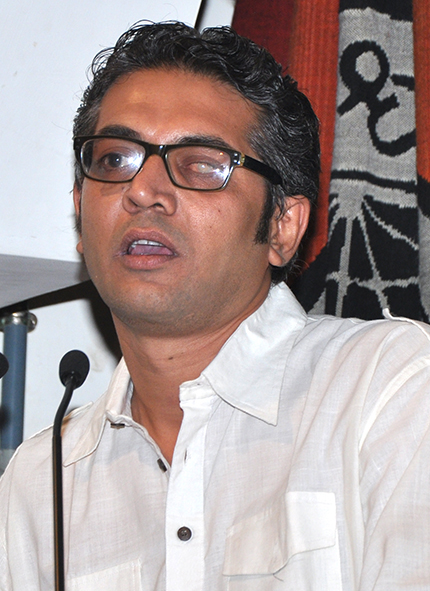
Joshi taught English literature in Ahmedabad for sixteen years and wrote plays on the side until he quit in September 2011 to do theatre full time. He has one poetry collection, Greenroomma, published in 2008, and it moves between ghazal, nazm, geet and free verse with a sex worker, a shepherd called Jetho and a boy in a Sivakasi fireworks factory among its subjects. That is the shape of a writer who works in Gujarati because Gujarati is the material, not because it is the market.
On Hellaro he is credited with lyrics, additional screenplay and dialogues, which is the rare case of one person controlling both what is said and what is sung in the same film. It is why the songs sound like speech that has run out of ordinary words rather than like decoration bolted onto a scene. Everything he brings to a screenplay was pressure tested in a room where nobody can cut away and there is no second take, and you can hear that discipline in the length of his lines.
Photo: Gujarat Vishw Kosh Trust, CC BY-SA 4.0, via Wikimedia Commons.
13Niren Bhatt
Bhatt is the only writer here who does both jobs at once: he writes the dialogue and he writes the songs. On Bey Yaar he took script and lyrics together, he wrote lyrics for Love Ni Bhavai and later for Jhamkudi, and in between he wrote Wrong Side Raju and Ventilator. Three Gujarati features is a small filmography and all three sit at the front of the industry's modern revival, which is the definition of a short runway used well.
Then he left, and the useful thing about what happened next is what it proves about the ear rather than the career. He wrote Bhediya, Munjya and Stree 2, is credited as co creator of the Maddock Supernatural Universe with Amar Kaushik, and has Filmfare nominations for Best Dialogue and Best Story. The comic timing that works in Hindi horror comedy was built writing Gujarati commercials, Gujarati plays and a Gujarati sitcom. Rhythm is portable across languages. Vocabulary is not, which is why so many Gujarati writers can go national and so few national writers can come the other way.
Instagram: @nirenbhatt (verified 2026-07-29).
14Raam Mori

Mori came from the page. His debut collection Mahotu won the Sahitya Akademi's Yuva Puraskar in 2017, its territory is rural Saurashtra and its centre of gravity is women, and the screen credits carry the same signature: Montu Ni Bittu, then 21mu Tiffin adapted from his own story about a woman running a tiffin service, then Nayika Devi, Kasoombo and Maharani. Reviewing Kutch Express, Harsh Desai of Mid-Day Gujarati named the dialogues by Mori in his praise, which is the sort of credit dialogue writers almost never get in Indian reviewing.
What he supplies is the register the industry could not manufacture. A film can hire an Ahmedabad copywriter to be funny and it cannot hire anyone to sound like a woman in a Saurashtra village who has been holding a household together for thirty years. That has to come from someone who grew up hearing it and then spent years learning to put it on a page. Mori is the industry's shortest route to that voice, and the fact that a Sahitya Akademi winning fiction writer is now a regular on commercial call sheets says more about where Gujarati cinema is heading than any box office figure does.
Photo: Farhad Shaikh, CC BY-SA 4.0, via Wikimedia Commons.
What the numbers say
Named varieties of Gujarati by group, as listed on English Wikipedia's Gujarati language article
Counted from the named varieties listed in the Dialects section of English Wikipedia's Gujarati language article, which totals 22 and matches the Linguistic Survey of India's note that nearly two dozen dialects were recorded. Kutchi is excluded from this count because most linguists classify it as a dialect of Sindhi. Gujarati cinema uses about four of these varieties with any regularity, and no Gujarati film on record has been made in Parsi Gujarati or Lisan ud-Dawat.
Questions people actually ask
How many dialects does Gujarati have?
The Linguistic Survey of India recorded nearly two dozen, and English Wikipedia's Gujarati language article lists 22 named varieties grouped mainly into Standard Gujarati, Amdawadi Gujarati and Kathiawari, plus the distinct Parsi variety and the Bohra community's Lisan ud-Dawat. Amdawadi Gujarati alone accounts for ten of them, including Surati, Charotari, Patidari and Vadodari.
Is Kutchi a dialect of Gujarati?
It is commonly called one and most linguists classify it as a dialect of Sindhi rather than of Gujarati. It is spoken in the Kutch region of Gujarat, in parts of Rajasthan and in Sindh in Pakistan. The distinction became a public argument when Ramesh Tanna, writing in Kutchmitra, criticised Hellaro for the absence of Kutchi in a film set in Kutch.
What dialect do Gujarati films usually use?
Amdawadi Gujarati is the industry default, because Ahmedabad holds the production base and much of the audience, and it functions as an unmarked register rather than a regional statement. Kathiawari appears when a film wants rootedness, as in Last Film Show, which was shot in Saurashtra with six local village boys cast. Surati is instantly recognisable within Gujarat and almost never carries a whole film.
What is Bhavai and why does it matter to Gujarati comedy?
Bhavai is a folk theatre form of Gujarat, also called Vesha or Swang, believed to have originated in the fourteenth century and traditionally credited to Asaita Thakar. Two of its conventions run straight into modern Gujarati screen comedy: the Nayak and the jester stay on stage throughout and comment on the action, and the humour targets the pompous behaviour of high caste people. Its own stage language is described as a blend of Hindi, Urdu and Marwari.
Which Gujarati film is best known for its dialogue?
Chhello Divas is the film audiences quote, though the claim that it runs on Amdavadi college slang is a widely shared reading rather than a sourced linguistic finding. Among recent releases, Kasoombo is the one whose dialogue reviewers named directly, with Meena Kansagara of TV9 Gujarati and Rachana Joshi of Mid-Day Gujarati both singling it out, and Raam Mori's dialogues for Kutch Express drew the same treatment from Mid-Day Gujarati.
Sources and image credits
All photographs are free-licensed files from Wikimedia Commons, reused with the attribution each licence requires. No press agency or studio photographs are hosted on this site. Instagram content is linked or embedded from the official account, never re-hosted.
- English Wikipedia, Gujarati language, Dialects section, retrieved July 2026, including the William Tisdall classification and the Linguistic Survey of India list of nearly two dozen dialects
- English Wikipedia, Kutchi language, Kathiawari, Gujarati languages, Parsi language and Gujarati theatre articles, retrieved July 2026
- English Wikipedia, Bhavai, for the Asaita Thakar origin account, the Nayak and jester convention, the performing caste names, the bhungal and the description of Bhavai's stage language
- English Wikipedia articles for Bhavni Bhavai, Chhello Divas, Last Film Show, Hellaro, Kasoombo, Vash, Vash Level 2, Laalo Krishna Sada Sahaayate, Kutch Express, Gujarati cinema, Siddharth Randeria, Sanjay Goradia, Pratik Gandhi, Monal Gajjar, Saumya Joshi, Niren Bhatt and Raam Mori
- Ramesh Tanna in Kutchmitra on Hellaro, as cited on the film's Wikipedia article, for the criticism of the absence of Kutchi language
- Meena Kansagara of TV9 Gujarati and Rachana Joshi of Mid-Day Gujarati on the dialogues of Kasoombo, and Harsh Desai of Mid-Day Gujarati on the dialogues of Kutch Express, as cited on those films' Wikipedia articles
- Wiktionary entry for the Gujarati word kasumbo, tracing it to Sanskrit kusumbha meaning safflower
- Wikimedia Commons imageinfo API for every photograph licence, photographer credit and description used on this page
- Instagram profile verification via the Apify Instagram scraper on 29 July 2026, for the Abhishek Shah and Niren Bhatt accounts