Gujarati film lyric writing sits on top of a literary tradition rather than beside one. Umashankar Joshi holds the only Jnanpith Award in this group, given in 1967 for the poetry collection Nishith, and Ramesh Parekh is the rare writer with both a Sahitya Akademi Award, in 1994 for Vitan Sud Beej, and two Gujarat State Best Lyricist awards for film songs. Behind them stand Narsinh Mehta, the 15th century poet saint whose Vaishnava Jana To was Gandhi's favourite, and Zaverchand Meghani, who walked Saurashtra village by village writing down the folk songs the industry still sings from.
Ask who made a Gujarati song and you get the composer's name, sometimes the singer's. The person who wrote the words is the last credit on the poster and the first one forgotten. That is a strange way to treat a language whose entire popular culture, from the garba ground to the bhajan mandali to the multiplex, runs on lines somebody sat down and wrote. Gujarati is unusual among Indian languages in how tightly its literary poetry and its film lyric are wound together. The same person who wins a Sahitya Akademi Award turns up in the credits of a film that played in Rajkot single screens.
This page covers both halves on purpose: the writers with verified film song credits, and the poets whose work became song without their ever going near a set. Some of them are alive and writing today. One of them died in 1488. Every entry says which kind of writer it is, because collapsing the two would be dishonest to both. What runs through all eighteen is a stubborn fact about this language: the sung line has always been the highest form in Gujarati, and the people who wrote it were bank clerks, paediatricians, district office staff, radio announcers and men who left school in second grade.
The list at a glance
| Writer | Writes | Era | Hardest credential |
|---|---|---|---|
| Ramesh Parekh | Geet, ghazal, film lyric | 1967 to 2006 | Sahitya Akademi Award 1994 plus two Gujarat State Best Lyricist awards |
| Barkat Virani 'Befam' | Ghazal, film lyric | 1937 to 1994 | Wrote film songs from Divadandi in 1950 onward while defining the modern Gujarati ghazal |
| Raeesh Maniar | Ghazal, film lyric | 1981 to present | Kalapi Award 2016 and songs for Kevi Rite Jaish, the film that opened the new wave |
| Milind Gadhavi | Ghazal, geet, film lyric | 2011 to present | 15th Transmedia Award for Best Lyrics for Premji: Rise of a Warrior |
| Saumya Joshi | Poetry, plays, film lyric | 1991 to present | Wrote the dialogues and the songs for Hellaro |
| Mareez | Ghazal | 1931 to 1983 | Called the Ghalib of Gujarat, with a career built entirely outside institutions |
| Adil Mansuri | Ghazal, absurd theatre | 1963 to 2008 | Kalapi Award 1998 and Vali Gujarati Award 2008 for modernising the Gujarati ghazal |
| Chinu Modi | Ghazal, long poem, fiction | 1958 to 2017 | Sahitya Akademi Award 2013 for the ghazal collection Khara Zaran |
| Rajendra Shukla | Ghazal | 1962 to present | Sahitya Akademi Award 2007 and Ranjitram Suvarna Chandrak 2006 |
| Khalil Dhantejvi | Ghazal, novels, plays | 1950s to 2021 | Padma Shri 2022, awarded posthumously, after schooling that stopped at fourth standard |
| Harindra Dave | Geet, ghazal, fiction | 1951 to 1995 | Sahitya Akademi Award 1978 for Hayati and Ranjitram Suvarna Chandrak 1982 |
| Anil Joshi | Geet, essays | 1962 to 2025 | Sahitya Akademi Award 1990, which he announced he was returning in 2015 |
| Tushar Shukla | Geet, essays, broadcasting | 1970s to present | Padma Shri 2025, with poems set in Gujarat and Maharashtra school textbooks |
| Narsinh Mehta | Bhajan and pada | 15th century | Honoured as Adi Kavi, first poet of Gujarati, and wrote Vaishnava Jana To |
| Kalapi | Ghazal, khandakavya | 1890 to 1900 | About 250 poems and 15,000 verses written before he died at twenty six |
| Zaverchand Meghani | Folk song, poetry, journalism | 1922 to 1947 | Titled Raashtreeya Shaayar by Gandhi and jailed in 1930 for a book of songs |
| Umashankar Joshi | Poetry, drama, criticism | 1931 to 1988 | Jnanpith Award 1967 for Nishith, the only one in this group |
| Dula Bhaya Kag | Folk and devotional song | 1920s to 1977 | Padma Shri 1962, and the eight volume Kagvani |
How this list was built
This list covers two overlapping groups: writers with verified Gujarati film lyric credits, and poets whose work entered the sung repertoire without a film credit. Every name was checked against its English Wikipedia biography, and every award year was cross checked against the source list for that award rather than taken from the writer's own page. That process caught real errors. Umashankar Joshi's own article lists his Jnanpith Award as 1968 in one place and 1967 in another; the Jnanpith Award's own record puts him in 1967, shared with Kuvempu, so 1967 is what appears here. Ramesh Parekh's page mentions a state level Gujarat Sahitya Akademi prize and the central Sahitya Akademi Award separately, and only the central award for Vitan Sud Beej in 1994 is claimed here. Padma Shri years were verified against the government recipient lists. Every entry also needed a free licensed photograph on Wikimedia Commons, checked by a file namespace search rather than by page image alone, and that filter cost this page its most painful omissions. Avinash Vyas, who composed for over 190 Gujarati films and won 25 Gujarat State film awards for lyrics and music, has no free licensed photograph and is not here. Neither is Venibhai Purohit, who wrote Taro Aankhno Afeeni, one of the most sung love songs in the language. Neither is Kavi Daad, a Padma Shri of 2021 who wrote songs for fifteen Gujarati films, nor Amrut Ghayal, nor Balmukund Dave. That five writers of that stature have no photograph anyone is free to publish is itself a comment on how Gujarat archives its own poets.
The lyricists writing for the screen
Five writers with verified Gujarati film song credits, from 1950 to the current wave.
1Ramesh Parekh

Parekh spent his working life inside a district office in Amreli, which he joined in 1960 and left on retirement in 1988. He did not begin writing poetry until 1967, and he began seriously only after meeting Anil Joshi in 1968, who told him to write more. What followed was one of the densest bodies of lyric work in the language: Kya in 1970, Khading in 1979, then Tva, Sananan, Khamma Ala Bapune, Meera Same Par and Vitan Sud Beej in 1989. The collected poems appeared in 1991 as Chha Akshar Nu Nam and sold through four editions in five years, which is not a thing that happens to poetry.
He is the cleanest proof that the film lyric and the literary lyric in Gujarati are the same muscle. The Sahitya Akademi gave him its Gujarati award in 1994 for Vitan Sud Beej. The Gujarat State Film Awards gave him Best Lyricist twice, in 1982-83 for Nasibni Balihari and in 1993-94 for Manvini Bhavai. Add the Ranjitram Suvarna Chandrak in 1986 and the Narsinh Mehta Award in 2004 and you have a writer the academy and the box office both signed off on. His Sonal and Meera poems are still the ones singers reach for first.
Photo: Chinu Modi, CC BY-SA 4.0, via Wikimedia Commons.
2Barkat Virani 'Befam'

Barkat Ali Virani wrote his first ghazal at fourteen, was taught poetry by Qismat Qureshi, and walked out of matriculation to join the Quit India movement in 1942. He moved to Mumbai in 1945 on the advice of the poet Shayda, whose elder daughter Ruqaiyya he married in 1952, and took a job at Aakashvani. Mareez was already in the city. The two of them, plus the radio, are most of the reason the Gujarati ghazal stopped sounding like a translation of Urdu and started sounding like Gujarat.
Befam is on this list because he did not treat the film song as a lesser form. He acted in Mangalfera in 1949 and wrote lyrics across Gujarati cinema, including Divadandi in 1950, Akhand Saubhagyavati in 1963, Jalam Sang Jadeja and Snehbandhan. Songs such as Nayanne Bandh Rakhine, Thay Sarkhamni To Utarata Chhie and Milan na Deepak Sahu Buzai Gaya Chhe travelled far past the films that carried them. He also wrote short stories, stage plays and radio plays, which is what a working writer looked like before anyone used the word content.
Photo: Musafir Palanpuri aka Amirmohammad, CC BY-SA 4.0, via Wikimedia Commons.
3Raeesh Maniar

Maniar published his first newspaper poem in Gujarat Samachar in December 1981, at fifteen. He then went to medical school, took an MD in paediatrics in 1991, practised in Surat, narrowed to developmental and behavioural child psychology in 2008, and in 2013 shut the clinic to write full time. The books that made his name are Kafiyanagar in 1989, Shabda Mara Swabhavma J Nathi in 1998 and Aam Lakhvu Karave Alakh Ni Safar in 2011. He also wrote the two textbooks Gujarati ghazal students actually use, Ghazal: Roop ane Rang in 2006 and Ghazal Nu Chhandovidhan in 2008, the second of which carries original prosody research.
The film work is the other half. He wrote songs for Kevi Rite Jaish in 2012, the film usually treated as the start of the new wave, and then for Aa To Prem Chhe, Vishwasghat, Polampol, Musafir, Vitamin She and Je Pan Kahish Te Sachu Kahish. In 2013 he wrote the background song Thai Dod Dod Gali Vaat Mod for Sanjay Leela Bhansali's Goliyon Ki Raasleela Ram-Leela. His translations of Kaifi Azmi, Gulzar, Sahir Ludhianvi and Javed Akhtar into Gujarati, and of Ghalib in Ghalibanama in 2019, are the reason a lot of Gujarati readers met those poets at all.
Photo: Ami Patel, CC BY-SA 4.0, via Wikimedia Commons.
4Milind Gadhavi

Gadhavi wrote his first poem in sixth standard and his first ghazal in eighth, and taught himself the metres in twelfth. He has an MBA from M. S. University, Vadodara, and has held a bank job in Junagadh since 2013, which tells you everything about what a poetry career pays in Gujarat. His work has run in most of the literary magazines that matter, including Kumar, Kavita, Navneet Samarpan, Shabdasrishti and Gazalvishwa, and he has recited on Doordarshan, Akashvani and at Asmitaparva, plus a mushaira in Nyeri, Kenya, in July 2015.
He is the youngest writer on this list and the clearest sign that the pipeline from mushaira to movie still works. His entry into cinema was a single song, Me to suraj ne ropyo chhe aangne, for Premji: Rise of a Warrior, and it won him the 15th Transmedia Award for Best Lyrics. He followed it with two songs for Thai Jashe!, both sung by Parthiv Gohil. He writes in ghazal, nazm, geet, sonnet, free verse, muktak, tripadi, anjani, triolet and villanelle, but the ghazal is the spine, and the subject is almost always the young heart doing its two settings, waiting and missing.
Photo: Panchalsonasan, CC BY-SA 4.0, via Wikimedia Commons.
5Saumya Joshi
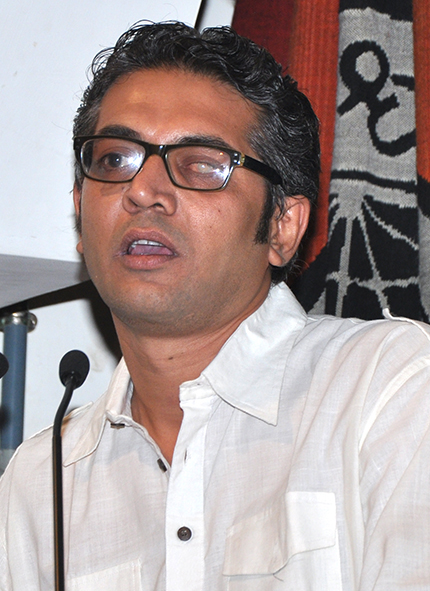
Joshi taught English literature at H. K. Arts College in Ahmedabad from 1995 and quit in September 2011 to do theatre full time, a year after founding the Fade-In Theatre. He started writing poems at eighteen and published his first in Kavilok. Greenroomma, published in 2008, is still his only poetry collection, and it is the reason he belongs on a page about words rather than scripts. It moves between ghazal, nazm, geet and free verse, and its subjects are a sex worker, the Rana whom Meera left, a boy in the Sivakasi fireworks factory, a shepherd called Jetho, and a labourer resting under a gunny bag to get out of the sun.
One collection, no follow up, and it still gets quoted. That is the tell of a poet who writes only when he has something. The lyric writing carried into cinema in 2018, when he wrote both the dialogues and the songs for Hellaro. Placing a Gujarati poet's vocabulary inside a film about women in the Rann of Kutch who dance because nothing else is left to them is the reason the songs land as speech rather than decoration. His awards sit on the literature side too: Yuva Gaurav Puraskar in 2007, the Takhtasinh Parmar Prize for 2008-09, and the Chandravadan Chimanlal Mehta Award in 2013.
Photo: Gujarat Vishw Kosh Trust, CC BY-SA 4.0, via Wikimedia Commons.
The ghazal engine
The form that gave Gujarati its most quotable lines, and the five men who built it.
6Mareez

Abbas Vasi left school in second grade because he had no interest in it, and his father put him on a train to Bombay to work. He spent his early twenties at Universal Rubber Works making rubber shoes and spending the wages on books. He learned his craft at Zhapa Bazar in Surat, where people who cared about Urdu and Gujarati ghazals gathered, and there he met Ameen Azad, whom he called his ustad and who gave him the pen name Mareez, meaning the patient or the ailing one. He first recited on All India Radio in Mumbai in 1936, helped by his friend the poet Asim Randeri.
He stayed broke his whole life. He edited magazines that folded for lack of money, worked at Vatan and Matrubhumi, and sold ghazals outright during bad stretches, which is why a quantity of his best work carries somebody else's name. The reputation arrived after he died in 1983. Gujarat now calls him the Ghalib of Gujarat, and Raeesh Maniar wrote a full biography and critical study of him in 2001. If you want the argument that Gujarati ghazal is a working class form rather than a drawing room one, Mareez is the whole argument.
Photo: Musafir Palanpuri aka Amirmohammad Sindhi, CC BY-SA 4.0, via Wikimedia Commons.
7Adil Mansuri
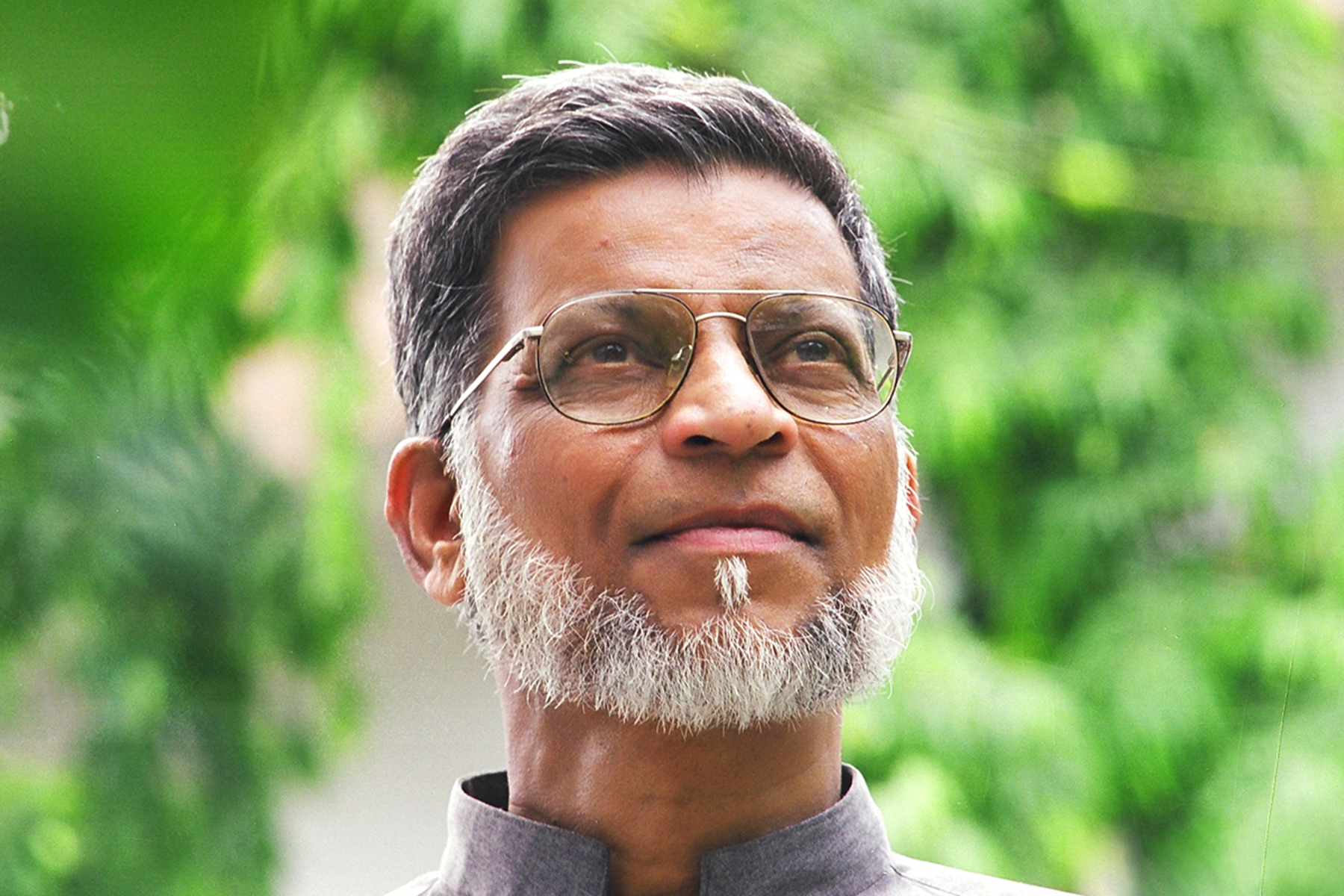
Born Farid Mohammed Ghulam Nabi Mansuri, he was educated in Ahmedabad and Karachi, got through matriculation, and then tried a run of businesses: his father's cloth shop in Karachi, cotton and cloth in Ahmedabad, journalism at English Topic and the Gujarati magazine Angana, and in 1972 a copywriting desk at the advertising agency Shilpi. He was also a painter with exhibitions in Ahmedabad and Mumbai in 1972, and a calligrapher. He later moved to the United States and died in New Jersey in 2008.
He is the writer most responsible for dragging the Gujarati ghazal into modern form. Valank in 1963, Pagarav in 1966 and Satat in 1970 pushed the shape of the thing, and New York Naame Gam, Male Na Male and Gazalna Aynagharma in 2003 followed. He wrote ghazals in Gujarati, Hindi and Urdu and let the three languages spill into each other inside a single line, which is exactly how Gujarati is actually spoken and almost never how it was written. His absurd one-act play collections, Haath Pag Bandhayela Chhe in 1970 and Je Nathi Te in 1973, did the same job to Gujarati theatre. He received the Kalapi Award in 1998 and the Vali Gujarati Award in 2008.
Photo: Sanjay Vaidya, CC BY-SA 4.0, via Wikimedia Commons.
8Chinu Modi

Modi took a BA in Gujarati and History in 1958, an LLB in 1960, an MA in Gujarati and Hindi in 1961 and a PhD in 1968 from Gujarat Vidyapith on khandakavya, the Gujarati narrative poem. He taught at colleges in Ahmedabad, Talod and Kapadvanj, and between 1975 and 1977 wrote scripts at ISRO in Ahmedabad, which is a sentence very few poets get to have. He published under the pen name Irshad, and worked across ghazal, long poem, novel, short story and criticism without treating any of them as the day job.
The award record is the widest on this list after Umashankar Joshi. The Ushnas Prize for 1982-83 for Bahuk, the Kalapi Award in 2000, the Teansmedia Award in 2004, the Narsinh Mehta Award in 2008, the Vali Gujarati Award in 2010, and the Sahitya Akademi Award for Gujarati in 2013 for the ghazal collection Khara Zaran. What that spread means is that the same writer satisfied the ghazal circuit, the academic critics and the national jury, three audiences that usually disagree on principle. He died in 2017 and Gujarati poetry has not really replaced him.
Photo: Sanjay Vaidya, CC BY-SA 4.0, via Wikimedia Commons.
9Rajendra Shukla

Shukla learned poetry from Takhtasinhji Parmar alongside Manoj Khanderia and Shyam Sadhu, published his first poem in Kumar in 1962, and took his MA in Sanskrit and Prakrit in 1967. He taught until 1982 and then voluntarily stopped, partly to educate his own children outside school as an experiment. His influences run from Narsinh Mehta, a fifteenth century saint poet, to the Re Math modernists of the 1960s, which is a range most poets would not survive. Komal Rishabh came in 1970, the long poem Swavachakni Shodh in 1972, Antar Gandhar in 1981, and the five volumes of Gazal Samhita in 2005.
The 1970 Gujarat government prize for best poetry anthology went jointly to his Komal Rishabh and to Ramesh Parekh, which is a neat marker of where Gujarati poetry stood that year. He then collected the Sanskar Chandrak in 1980, the Kavi Nhanalal Prize in 1981, the Kalapi Award in 2001, the Gujarat Sahitya Akademi award in 2005 for Gazal Samhita, both the Narsinh Mehta Award and the Ranjitram Suvarna Chandrak in 2006, the Sahitya Akademi Award in 2007 for the same Gazal Samhita, the Narmad Suvarna Chandrak in 2008 and the Vali Gujarati Gazal Award in 2009. He is married to the poet Nayana Jani and lives in Ahmedabad.
Photo: Gazal world, CC BY-SA 4.0, via Wikimedia Commons.
10Khalil Dhantejvi

He was born Khalil Ismail Makrani in the village of Dhantej and took his pen name from it. He studied to fourth standard and stopped. What he then produced is a shelf that most full time literary academics do not match: ghazal collections including Sadgi, Saransh in 2008, Sarovar in 2018, Sogat, Sooryamukhi, Sayba, Sanvariyo, Sagpan, Sopan and Sarangi, sixteen novels including Dr. Rekha in 1974, Tarasya Ekant in 1980 and Mukam Post Zakal, and four plays. He wrote in Gujarati and in Urdu.
The recognition came late and then came heavily. The Kalapi Award in 2004, the Vali Gujarati Gazal Award in 2013, the Narsinh Mehta Award in 2019, and then the Padma Shri in 2022 for literature and education, announced after his death in April 2021. Two of the three writers on this list holding a Padma Shri had barely any formal schooling, which is a fact worth sitting with. Gujarati ghazal has always been written by people who learned it in a bazaar or a mushaira rather than a syllabus, and Dhantejvi is the cleanest example of it in the modern period.
Photo: Sanjay Vaidya, CC BY-SA 4.0, via Wikimedia Commons.
The geet poets whose lines left the page
Three writers whose sung lyric reached further than their books did.
11Harindra Dave

Dave wrote more than fifty books and edited newspapers for forty years at the same time. He was at the Gujarati daily Janashakti from 1951 to 1962, edited the monthly Samarpan for Bhavan's, spent 1968 to 1973 at USIS, returned to Janashakti as editor in 1973 and wrote through the Emergency, then took over as editor in chief of Janmabhoomi, Pravasi and Janambhoomi-Pravasi. Before all of that, in the years before 1951, he worked at the film magazine Chitrapat and met Guru Dutt, Mehboob Khan, Suraiya, Motilal, Mohammed Rafi and Ramanand Sagar.
His poetry is where Krishna stops being a deity and becomes a person who has left. Aganpankhi came in 1962, Hayati in 1978, Lohi no Rang Lal in 1981, Gandhi Ni Kavad in 1984, and Krishna ane Manav Sambandho in 1982 is a full length study of the Krishna theme in human relationships. His novel Madhav Kyayn Nathi, published in 1970, was translated into Hindi in 1995. The Sahitya Akademi gave him its Gujarati award in 1978 for Hayati and he took the Ranjitram Suvarna Chandrak in 1982, plus the Kabir Award from Madhya Pradesh and a Goenka award for journalism.
Photo: Deeptali, CC BY-SA 3.0, via Wikimedia Commons.
12Anil Joshi

Joshi taught Gujarati from 1962, worked as personal assistant to the editor Vadilal Dagli from 1971 to 1976, and finished his working life as adviser on Gujarati to the Mumbai Municipal Corporation's language development project. His first poem ran in Kumar in 1962. He was part of Re Math, the modernist movement that reset Gujarati poetry in the 1960s. His collections are Kadach in 1970, Ame Barafna Pankhi in 1981 and Paniman Ganth Padi Joi in 2012, and although he wrote free verse and ghazal, the form he is known for is geet, the sung lyric.
He is also the reason Ramesh Parekh kept writing. The two met in Amreli in 1968, became close, and Joshi pushed him to take poetry seriously. The Sahitya Akademi Award came in 1990, oddly enough not for the poetry but for the essay collection Statue. In October 2015 he announced he was returning it over the killing of the rationalist M. M. Kalburgi and others, one of the few Gujarati writers to do so. He died in Mumbai in February 2025 at eighty four, and the geet tradition lost its most stubborn practitioner.
Photo: Sanjay Vaidya, CC BY-SA 4.0, via Wikimedia Commons.
13Tushar Shukla

Shukla is the son of the Gujarati playwright and poet Durgesh Shukla, was schooled in Gujarati medium at Swastik Shishu Vihar in Ahmedabad, read Gujarati and English literature at St. Xavier's College, took an MA from Gujarat University's School of Languages and an LLB he never practised on. He joined All India Radio as an announcer and retired as station director of AIR Rajkot, producing children's and youth programmes on the way, including Shanabhai and Shakrabhai. He has written more than thirty books and columns for Gujarat Samachar and Divya Bhaskar.
His poetry collections include Tari Hatheli Ne, Maaro Varsad, Puchhine Thay Nahi Prem, Mann Masti ane Motor Cycle and Aashka, and his poems are set in school textbooks in both Gujarat and Maharashtra. That last detail is the real credential. A poem in a syllabus is read by a few million children who did not choose it and remember it anyway, which is a distribution channel no publisher can buy. In 2025 he received the Padma Shri for literature and education, making him the most recently decorated writer on this list.
Photo: CitationNeeded99, CC0, via Wikimedia Commons.
The foundation the lyric stands on
Five writers, one of them from the fifteenth century, whose work is the raw material everyone else sings.
14Narsinh Mehta

Mehta is where the Gujarati lyric starts. He is honoured as Adi Kavi, the first poet of the language, and almost everything known about his life comes from his own compositions and from poems written about him later, because there is no formal record from the period. Born in Talaja to a Nagar Brahmin family, orphaned at five, treated badly in his brother's house in Junagadh, he became a devotee of Krishna and spent his life composing bhakti poems. He sang and danced them in the company of anyone who turned up, regardless of caste, which is why the Nagar Brahmin community of Junagadh turned on him.
His bhajans have stayed in circulation for more than five centuries in Gujarat and Rajasthan, which no film song will manage. Vaishnava Jana To was Mahatma Gandhi's favourite and travelled with the freedom movement across India, and it is still sung at state occasions. He belongs on a page about lyricists not as a competitor to them but as the source: every geet writer in this language is working inside a form he set. He is included here as heritage context, and the only free licensed image of him available is a 1967 commemorative postage stamp rather than a portrait, because nobody drew him from life.
Photo: India Post, Government of India, GODL-India, via Wikimedia Commons.
15Kalapi

Sursinhji Gohil was the ruler of Lathi, a small state in Saurashtra, and he was dead at twenty six. His father died when he was five and his mother when he was fourteen, he went to Rajkumar College in Rajkot at eight and dropped out at seventeen having read English, Sanskrit and contemporary Gujarati literature harder than the syllabus asked. In the years he had left he wrote about 250 poems running to roughly 15,000 verses, prose, and more than 900 letters to friends and wives, and translated four English novels into Gujarati.
He wrote in the strict metres, Mandakranta, Shardulvikridit, Shikharini, and still sounds like someone talking. Aapni Yadi is among the best known ghazals in the language. He also ran what amounted to a workshop at the Lathi court: Kavi Lalitji arrived as a tutor to the royal children, fell under his influence and became Rajya Kavi of Lathi. The circumstances of his death in 1900 are still argued over, recorded as cholera and disputed since. The Kalapi Award, one of the honours several writers on this page hold, is named after him.
Photo: Photographer not recorded, public domain, via Wikimedia Commons.
16Zaverchand Meghani

Meghani is the single most important name on this page for anyone who cares about where Gujarati song material comes from. He matriculated in 1912, took a BA in 1917, worked in Kolkata for a metals company and was promoted to factory manager, then walked away from it, came back to Saurashtra and joined the weekly Saurashtra at Rajkot in 1922 as an editor. His first book, in 1922, was Kurbani Ni Katha, a translation of Tagore. He then went village to village across Saurashtra collecting folk songs and folk tales and published them in the volumes of Saurashtra Ni Rasdhar. More than 100 books carry his name.
He wrote the songs the freedom movement sang, and in 1930 the British jailed him for two years for Sindhudo, a book of songs written to move the young into the independence struggle. Gandhi gave him the title Raashtreeya Shaayar, national poet, on the spot. He took the Ranjitram Suvarna Chandrak in 1928 and the Mahida award in 1946 for Mansai Na Deeva, edited Phoolchhab, and his poems are taught in Gujarat board schools today. Every folk singer and every film composer working in the Saurashtra idiom is drawing, knowingly or otherwise, on material he wrote down before it disappeared.
Photo: Photographer not recorded, public domain, via Wikimedia Commons.
17Umashankar Joshi

Joshi was born in a village called Bamna in what is now Aravalli district, one of nine children, and spent two years in fourth standard because the teacher was absent. He got to Ahmedabad in 1927 and later called that the break of his life. He joined the Sahitya Akademi's general council and executive committee at its founding in March 1954, became professor of Gujarati at Gujarat University in June that year and headed its School of Languages until he retired in 1972, was Vice Chancellor of the university in 1970, was nominated to the Rajya Sabha the same year, and served as president of the Sahitya Akademi from 1978. During the Emergency he argued publicly for free speech.
He is the only Jnanpith laureate on this list, awarded in 1967 for the poetry collection Nishith and shared that year with the Kannada poet Kuvempu. The Sahitya Akademi gave him its Gujarati award in 1973 for Kavini Shraddha, and he had already taken the Ranjitram Suvarna Chandrak in 1939 and the Narmad Suvarna Chandrak in 1943. His work runs from Vishwashanti and Gangotri through Nishith, Mahaprasthan and Abhigna, plus the story collections, the plays, translations of Kalidasa and Bhavabhuti, and the magazine Sanskruti which he edited. Gujarat Mori Mori Re is his, and it is still sung.
Photo: Apurva Madia, CC BY-SA 4.0, via Wikimedia Commons.
18Dula Bhaya Kag

Kag had five years of schooling before he left to tend the family cattle and farm. He joined the nationalist movement, and after Saurashtra State was formed he donated 650 bigha of his own land to Vinoba Bhave's Bhoodan movement. His major work is Kagvani, eight volumes of devotional songs drawn from episodes of the Ramayana and the Mahabharata, alongside songs built on Gandhian thought and the Bhoodan campaign. He wrote eulogies for Gandhi and for Bhave, and poems on Sonal Aai and on Yogiji Maharaj.
He is on this list because the boundary between folk poet and lyricist barely exists in Saurashtra. What Kag wrote entered the singing repertoire directly and stayed there, and his verse is now taught from primary school to master's level despite his own education stopping at fifth grade. The Government of India gave him the Padma Shri in 1962 for literature and education. Majadar village was renamed Kagdham after him, India Post issued a five rupee commemorative stamp on 25 November 2004 for his 102nd anniversary, and the Kavi Kag Award is given every year to five scholars of literature.
Photo: India Post, Government of India, GODL-India, via Wikimedia Commons.
What the numbers say
Top honours held by the eighteen writers on this list
Counts cover only the eighteen writers profiled on this page, not the full recipient lists for these honours. Each year was verified against the awarding body's own recipient record.
Questions people actually ask
Who is the greatest Gujarati poet?
By the highest national honour it is Umashankar Joshi, who won the Jnanpith Award in 1967 for the poetry collection Nishith, shared that year with the Kannada poet Kuvempu, and the Sahitya Akademi Award in 1973 for Kavini Shraddha. By influence on how the language is actually sung, most Gujarati readers would name Narsinh Mehta, the fifteenth century poet saint whose bhajans have been in continuous circulation for five hundred years.
Who wrote the most Gujarati film songs?
The most prolific figure in Gujarati film music was Avinash Vyas, who worked as both lyricist and composer across more than 190 Gujarati films and won Gujarat State film awards 25 times for lyrics and music. He is not profiled on this page because no free licensed photograph of him exists, and this site does not publish an entry without one.
What is the difference between a Gujarati geet and a ghazal?
A geet is a sung lyric in Gujarati that follows its own metre and usually builds one continuous feeling, and it is the form Anil Joshi and Ramesh Parekh are known for. A ghazal is a series of self contained couplets held together by rhyme and refrain, imported from Urdu and Persian and reshaped in Gujarati by Mareez, Barkat Virani, Adil Mansuri, Chinu Modi and Rajendra Shukla.
Which Gujarati poets have won the Padma Shri?
Three writers on this list hold it: Dula Bhaya Kag, the folk poet and songwriter, in 1962; Khalil Dhantejvi, the ghazal poet, posthumously in 2022; and Tushar Shukla in 2025, in the literature and education category. Two of the three had almost no formal schooling, Kag stopping at fifth grade and Dhantejvi at fourth standard.
Are Gujarati film lyricists usually published poets?
Very often, yes, and that is the defining feature of the industry. Ramesh Parekh held a Sahitya Akademi Award and two Gujarat State Best Lyricist awards. Raeesh Maniar wrote two standard textbooks on ghazal prosody before writing songs for Kevi Rite Jaish. Saumya Joshi published the poetry collection Greenroomma a decade before he wrote the songs for Hellaro. Milind Gadhavi was publishing in Kumar and Kavita before his first film song won him a Transmedia award.
Sources and image credits
All photographs are free-licensed files from Wikimedia Commons, reused with the attribution each licence requires. No press agency or studio photographs are hosted on this site. Instagram content is linked or embedded from the official account, never re-hosted.
- English Wikipedia biographies of Ramesh Parekh, Barkat Virani 'Befam', Raeesh Maniar, Milind Gadhavi, Saumya Joshi, Mareez, Adil Mansuri, Chinu Modi, Rajendra Shukla, Khalil Dhantejvi, Harindra Dave, Anil Joshi, Tushar Shukla, Narsinh Mehta, Kalapi, Jhaverchand Meghani, Umashankar Joshi and Dula Bhaya Kag, retrieved July 2026
- English Wikipedia, List of Sahitya Akademi Award winners for Gujarati, used to verify every Sahitya Akademi year and cited work
- English Wikipedia, Ranjitram Suvarna Chandrak recipient list, used to verify Meghani 1928, Umashankar Joshi 1939, Harindra Dave 1982, Ramesh Parekh 1986 and Rajendra Shukla 2006
- English Wikipedia, Jnanpith Award recipient table, used to place Umashankar Joshi in 1967 for Nishith alongside Kuvempu
- English Wikipedia, List of Padma Shri award recipients for 1960 to 1969, 2020 to 2029, used to verify Dula Bhaya Kag 1962, Khalil Dhantejvi 2022 and Tushar Shukla 2025
- Wikimedia Commons file namespace search and imageinfo licence metadata for every photograph used, checked July 2026
- English Wikipedia category sweep of Gujarati-language poets, 133 articles, used to surface candidates beyond the initial shortlist