Gujarati cinema is based in Ahmedabad, which is where the production houses, the distributors and most of the shoots sit. Surat is the second market and the only city that built its own Rs 108 crore auditorium, reported, and funds an annual municipal drama competition that reached its forty second edition in 2014. Vadodara holds the training, through the Faculty of Performing Arts at M. S. University, and it is where the state built a film studio in 1972. Rajkot is the Saurashtra market town where Dwarkadas Sampat bought a projector and started showing films before there was an industry. Kutch is where the camera goes: Hellaro and Kutch Express were both shot there.
Ask where Gujarati cinema is made and the honest answer is a list of postcodes, not a studio lot. English Wikipedia says the industry is based in Ahmedabad, and that is true in the way a head office is true. The money is signed in Gandhinagar, the actors are trained in Vadodara, the audience that kept the lights on from 2005 to 2012 lived in Banaskantha, the folk repertoire the films keep borrowing belongs to Saurashtra and Kutch, and a large share of the companies that produce and release these films are registered in Mumbai. This is an industry spread across a state, and until you map it, half its behaviour looks random.
So this page is a map rather than a ranking. Each entry is a place, and each place gets asked the same four questions. What gets made here. Who works here. Which rooms and screens matter. And what the local audience actually buys. Every claim below is checked against an encyclopedia entry, a government page, a company's own filing or a photograph with a licence attached. Where a figure is a company claim or a press claim rather than an audited one, it says so in the sentence, because the fastest way to write nonsense about this industry is to repeat a round number nobody sourced.
The list at a glance
| Place | Role in the industry | What is verified there | Audience |
|---|---|---|---|
| Ahmedabad | Production capital | Gujarati cinema is based here; Kevi Rite Jaish, Bey Yaar and Chhello Divas were shot here | Urban multiplex, the market the 2012 revival was built for |
| Surat | Second market and civic patron | Sanjeev Kumar and Pratik Gandhi were born here; the municipal drama competition reached its 42nd edition in 2014 | Large, moneyed, opens in week one alongside Ahmedabad |
| Vadodara | The training city | Faculty of Performing Arts at M. S. University; state film studio established 1972 | Long runs; Kevi Rite Jaish ran ten weeks here |
| Rajkot | Saurashtra's market town | Dwarkadas Sampat started with a projector here; Kirtidan Gadhvi is based here | Week two market on most releases |
| Kutch and Bhuj | The location | Hellaro built a fifteen bhunga set near Kuran; Kutch Express shot across the district | Regional, and the source of the folk repertoire |
| Junagadh and the Saurashtra interior | The source material | Narsinh Mehta lived here; Pan Nalin grew up in Amreli district | Small towns and single screens |
| Bhavnagar | The literary supply line | Narsinh Mehta was born at Talaja; Kirtidan Gadhvi taught at Bhavnagar University | Week two market |
| Banaskantha and north Gujarat | The rural demand engine | The post 2005 boom was driven by demand here | Working class, single screen, musical and dialect led |
| Gandhinagar | Where the cheque is signed | The 2016 incentive policy and the 2019 state award order came from here | Administrative, not commercial |
| Tagore Memorial Hall, Ahmedabad | The city's proscenium room | B. V. Doshi design, 700 seat bowl, listed by the municipal heritage department | Theatre and concert audiences |
| Drive-In Cinema, Ahmedabad | The open air screen | Operating since 1973, room for 665 cars, sells tickets on BookMyShow | Family and price sensitive |
| Mumbai | The offshore capital | Twenty Gujarati owned companies operated here between 1913 and 1931; the commercial Gujarati stage is still a Mumbai business | Diaspora and the Gujarati speaking city |
How this list was built
Entries are places, meaning cities, districts and named venues, and each one had to earn its line with a documented connection to Gujarati film or the stage that feeds it: a shoot, a company address, a training institution, a named person's origin, a release pattern or a policy signed there. Facts come from English Wikipedia city, film and biography articles, the Gujarati cinema article, Ahmedabad Municipal Corporation's heritage listing, the Banaskantha district administration site, Surat Municipal Corporation's facility pages and the venue operators' own sites, each read directly rather than through a summary. Four places were researched and dropped for failing the photograph rule this site runs on. The Sanjeev Kumar Auditorium at Pal in Surat has a strong record and no free licensed photograph, so its facts sit inside the Surat entry instead of getting a card of their own. The Gujarat state film studio built in Vadodara in 1972 has no photograph and no surviving address in the public record, so it appears as a fact rather than an entry. Jamnagar and Bharuch both show up in verified release patterns and neither has enough film specific documentation to carry two paragraphs. Two claims are labelled rather than asserted: the Rs 108 crore cost of the Surat auditorium circulates widely in press and reference listings without a municipal document behind it, and the Drive-In Cinema's largest screen in Asia line is the operator's own claim. Institutions that already have their own page on this site, including the drama and design schools and the theatre companies, are referenced here but not repeated as entries.
The four cities that make and sell the films
Ahmedabad, Surat, Vadodara and Rajkot are not four equal markets. They are four different jobs.
1Ahmedabad

Ahmedabad is where the 2012 revival was manufactured, and you can see the manufacturing in the production notes. Abhishek Jain's cinematographer on Kevi Rite Jaish, Pushkar Singh, came to the city a full year before principal photography to study its light and shot a video about it during pre production. The film was then made on a RED camera in Ahmedabad, and its premiere was held at Cinepolis in the city. Two years later Bey Yaar was shot at fifty different locations in thirty five days, all of them in Ahmedabad, with Jain saying openly that the point was to get the essence of the city into every scene, and its trailer was launched at Alpha One Mall. Chhello Divas used Shanti Business School and the Sabarmati Riverfront. This is not a city that films happen to be shot in. It is the subject.
The infrastructure sits here too, and most of it is unglamorous. Rupam Entertainment runs from Ashram Road and is the distributor of record on a long run of the decade's biggest reported grossers, with its group site describing distribution across around 300 screens in Gujarat. The talent pipeline is local and cheap: The Comedy Factory has been running an open mic and touring circuit out of Ahmedabad since 2011 and has built an audience of more than half a million on Instagram alone, and Saumya Joshi went from teaching English at H. K. Arts College to founding Fade-In Theatre in 2010 to writing the dialogues and lyrics for Hellaro. Even the older public money passed through here. Bhavni Bhavai in 1980 was financed by the National Film Development Corporation, the Sanchar Film Cooperative Society and a district bank in Ahmedabad, which tells you the city was underwriting Gujarati film risk four decades before anyone called it a revival.
Photo: Sneha G Gupta, CC BY-SA 4.0, via Wikimedia Commons.
2Surat

Surat's contribution to Indian cinema is two actors and a building. Sanjeev Kumar was born here as Harihar Jethalal Jariwala on 9 July 1938 and won two National Film Awards for Best Actor, for Dastak in 1970 and Koshish in 1972, before dying at forty seven. Pratik Gandhi was born here on 28 April 1980, worked as an industrial engineer at the National Productivity Council and then Reliance Infrastructure until 2016, and led Wrong Side Raju, which took the National Film Award for Best Feature Film in Gujarati. Two of the most serious performers Gujarat has produced came out of the same city, three generations apart, and neither of them trained in a film school.
The building is the interesting part, because it is the only case in this map of a city government putting real capital into a performance venue. Surat Municipal Corporation runs the Sanjeev Kumar Auditorium at Pal, named for the actor, at a cost widely reported as Rs 108 crore, and the figure circulates in press and reference listings rather than in a municipal document, so treat it as reported. What is documented is the use. The corporation runs an annual drama competition that The Times of India covered at its forty second edition in September 2014, staged at that auditorium, with twelve plays performed live at nine in the evening and results announced in late September. A city with diamond money and a municipal budget in the thousands of crores has chosen to spend a slice of it keeping amateur Gujarati theatre alive, and that is a supply line no producer pays for.
Photo: RahulR.Bhadane, CC BY-SA 4.0, via Wikimedia Commons.
3Vadodara

Vadodara calls itself the cultural city and for once the civic slogan is load bearing. The Faculty of Performing Arts at M. S. University traces back to the Academy of Indian Music founded under Sayajirao Gaekwad III on 26 February 1886, forty six years before the first Gujarati talkie existed, and it now runs the state's main dramatics department and awards BPA and MPA degrees. Kirtidan Gadhvi took both of those degrees here in music, taught at Bhavnagar University, and then went out and became the biggest dayro voice in Gujarat. The Faculty of Fine Arts on the same campus supplies the design and art direction side. If a Gujarati film has a trained performer or a trained art department in its credits, there is a decent chance the training happened within a kilometre of the Laxmi Vilas Palace.
Vadodara is also the site of the industry's one attempt at hardware. When the Gujarat government opened the subsidy taps in the 1970s, it established a film studio here in 1972. It did not survive as an industrial base, and the Gujarati cinema record notes that after the 1960 split from Bombay the state simply lacked major production houses and studios, which is exactly why quality collapsed once the subsidy money arrived. The commercial side of the city still shows up in release patterns rather than production. Chhello Divas shot across Ahmedabad and Vadodara, Kevi Rite Jaish ran ten weeks here, and Bey Yaar opened in the city in its first week alongside Ahmedabad and Surat. Vadodara trains people and then buys tickets to watch them.
Photo: Emmanuel DYAN, CC BY 2.0, via Wikimedia Commons.
4Rajkot

The Gujarati exhibition business began in Rajkot with one man and one machine. Dwarkadas Sampat bought a projector here and held film shows, then went into production with S. N. Patankar as Patankar Friends and Company, and later founded the Kohinoor Film Company, which turned out social films in an era dominated by mythologicals. Kohinoor's first film, Sati Parvati in 1920, put Gujarati culture on screen and cast Prabha, an actress from Rajkot, as Parvati. Sampat also played Vidur in Bhakta Vidur in 1921 wearing a Gandhi cap, which got the film banned by the British and made it the first film banned in India. All of that traces back to a projector bought in a Saurashtra market town.
Today Rajkot's function is different and much more commercial. It is the capital of the Saurashtra folk economy, which is where a large part of the modern Gujarati music business physically lives. Kirtidan Gadhvi is based here, and his stated reason is logistics rather than sentiment: it is the most convenient place to be for travel between events. Hemant Chauhan was born in Kundni village in Rajkot district, released Dasi Jivan na Bhajano in 1978 and has recorded more than 5,000 bhajans since. On the exhibition side, Rajkot is a week two city on most releases. Bey Yaar opened in Ahmedabad, Surat and Vadodara, then went to Rajkot, Jamnagar and Bhavnagar in the second week after a strong start, and Kevi Rite Jaish held special screenings here with the crew. That two step release pattern is the Gujarati distribution model in miniature.
Photo: Trinidade, CC BY-SA 4.0, via Wikimedia Commons.
The regions that supply the material
Every few years the industry runs out of urban stories and goes back to the same four districts.
5Kutch and Bhuj

Kutch is the industry's back lot, and it is enormous. The district covers 45,674 square kilometres, which makes it larger than the whole of Haryana or Kerala, and its headquarters at Bhuj was the capital of a princely state until 1947. When Abhishek Shah made Hellaro, he did not find a village to shoot in, he built one: a set of fifteen bhungas, a town square and a temple erected in the Rann of Kutch near Kuran village. The story itself came from the folklore of Vrajvani village. That film went on to become the first Gujarati film to win the National Film Award for Best Feature Film, at the 66th National Film Awards. Four years later Kutch Express set its story in Bhuj and shot across the district, produced by Parthiv Gohil and Manasi Parekh under Soul Sutra, and took three awards at the 70th National Film Awards.
The district also supplies voices. Geeta Rabari was born in 1996 in Tappar village and sings bhajan, lokgeet, santvani and live dayro. Mooralala Marwada was born in 1955 in Janana village, is the eleventh generation of Meghwal singers from that village, and sings Kabir, Mirabai and Ravidas in the Kafi form. Both are working artists with real audiences and neither needed the film industry to find them. There is a sharp criticism buried in this too, and it deserves airing. Ramesh Tanna, writing in Kutchmitra, praised Hellaro and then pointed out that a film set in Kutch contained no Kutchi language. The industry treats the district as scenery and repertoire more often than it treats it as a place with its own tongue.
Photo: Bhargavinf, CC BY-SA 3.0, via Wikimedia Commons.
6Junagadh and the Saurashtra interior

The Saurashtra interior is the reason Gujarati cinema has a canon at all. Narsinh Mehta, the 15th century poet saint honoured as the first poet of the Gujarati language, was born at Talaja and spent his hard years in Junagadh singing bhajans in company that ignored caste and class. When the industry needed a subject for its first full length talkie, it went straight to him: Narsinh Mehta, released on 9 April 1932, directed by Nanubhai Vakil and produced by Sagar Movietone. Jhaverchand Meghani was born at Chotila in 1896, collected and wrote the Saurashtra folk literature that Gandhi's title of Raashtreeya Shaayar recognised, and his novels were still being filmed decades after his death, as Vevishal in 1949 and Mansai na Deeva in 1984.
The region kept producing filmmakers as well as material. Pan Nalin was born in the remote village of Adtala in Amreli district and helped his father sell tea on the platform at Khijadiya Junction railway station until he was twelve, which is the raw material of Chhello Show, the semi autobiographical film that won Best Gujarati film at the 69th National Film Awards and was India's entry for the Best International Feature Film at the 95th Academy Awards. Aditya Gadhvi came out of Surendranagar and won ETV Lok Gayak Gujarat. There is a pattern here worth naming. Ahmedabad supplies the crew and the capital. This belt supplies the biography.
Photo: Arian Zwegers, CC BY 2.0, via Wikimedia Commons.
7Bhavnagar

Bhavnagar's claim on this map is quieter than Rajkot's and older than Ahmedabad's. Narsinh Mehta was born at Talaja, which sits in Bhavnagar district, which makes this the origin point of the story the industry chose for its very first sound feature in 1932. The city itself was founded in 1723 by Bhavsinhji Gohil, was the capital of Bhavnagar State, and holds the distinction of being the first princely state to merge voluntarily into the Union of India, in January 1948. It has the fifth largest population in the state and sits on a coast whose other famous industry, the Alang ship breaking yard about fifty kilometres away, is about as far from cinema as an economy can get.
In the modern industry Bhavnagar functions as a teaching post and a week two market. Kirtidan Gadhvi, after taking his BPA and MPA at M. S. University in Vadodara, taught music at Bhavnagar University before moving to Rajkot and going full time on the dayro circuit, which means one of the most commercially successful voices in Gujarat spent part of his career on a Bhavnagar salary. On the release side, the city behaves like Rajkot and Jamnagar: Bey Yaar opened in the three big cities, and only after a strong first week did the distributor extend it to Rajkot, Jamnagar and Bhavnagar. That sequencing is not a slight. It is how a small industry manages print and screen costs, and Bhavnagar is one of the cities that decides whether week two happens at all.
Photo: Bernard Gagnon, CC BY-SA 3.0, via Wikimedia Commons.
8Banaskantha and rural north Gujarat

For about eight years the economic centre of Gujarati cinema was not a city at all. After the state announced in 2005 a full entertainment tax exemption for films certified U and U/A, a 20 percent tax on A certificates and a Rs 5 lakh subsidy, production climbed, and the record is explicit about who was buying: demand rose in rural north Gujarat, especially Banaskantha district, from a working class audience that wanted local musical and dialect led films, and those films played mostly in single screen cinemas. Output went past sixty films a year in 2009 and 2010 and hit a record seventy two in 2012. That is more Gujarati films in one year than the entire decade of the 1950s produced, and almost none of them were aimed at Ahmedabad.
The face of that market was Vikram Thakor, who has acted in more than forty Gujarati films made chiefly for rural audiences, and whose six films for that audience earned a reported Rs 3 crore, which the press of the time was happy to call superstardom. Kinjal Dave came out of the same belt, born in 1998 at Jesangpura near Patan, and went from folk singles to a film debut in 2018. Then the state discontinued the Rs 5 lakh subsidy in August 2013, and the volume that this audience had supported thinned out while a completely different urban film, made in Ahmedabad for multiplexes, took over the conversation. Both markets are real. Only one of them gets written about, which is why Laalo's success in 2025 with a devotional drama surprised so many people who should have known better.
Photo: Ketancmaheshwari at English Wikipedia, public domain, via Wikimedia Commons.
The rooms, the money and the city that is not in Gujarat
Four places that are not markets in the ordinary sense, and that decide a great deal anyway.
9Gandhinagar
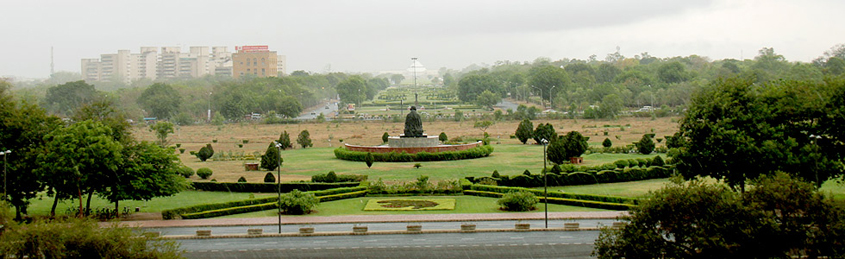
Gandhinagar has no studios, no cinema culture worth the name and more influence over Gujarati film economics than any other place on this page. The capital was planned from scratch by Prakash M. Apte and H. K. Mewada, sits about twenty three kilometres north of Ahmedabad on the Sabarmati, and houses the department that decides what a Gujarati film is worth. The current framework was announced in February 2016 and grades films from A to D on technical quality, production quality, film components and box office performance, paying Rs 50 lakh, Rs 25 lakh, Rs 10 lakh or Rs 5 lakh, or 75 percent of production cost, whichever is lower. The same policy directs multiplexes to hold at least forty nine screenings of Gujarati films a year, which is a distribution mandate dressed as a cultural clause.
The paperwork is real and it is worth reading. The Information and Broadcasting Department published the Quality Integrated Incentive Policy for Gujarati Films 2019 through resolution FLM/102018/151/A dated 8 March 2019, and the 2019 round of the Gujarat State Film Awards was signed out through resolution FLM/102018/357/A on 17 March 2021, running to forty six separate prize lines with cash purses from Rs 21,000 to Rs 2,50,000. Eight of those lines were left empty because the committee selected nobody. Read that against the older history, when the state's subsidy regime cost it Rs 8 crore in 1981 and 1982 for thirty nine films and produced a collapse in quality, and the modern grading policy stops looking bureaucratic and starts looking like a lesson learned the expensive way.
Photo: Prime Minister's Office, Government of India, CC BY-SA 2.0, via Wikimedia Commons.
10Tagore Memorial Hall, Ahmedabad

Every performance culture needs a room, and in Ahmedabad the room is Tagore Hall. B. V. Doshi designed it in 1961, construction started in 1966 and finished in 1971, and it is one of the clearest pieces of brutalist architecture in the city, listed by the Ahmedabad Municipal Corporation's heritage department. The lobby opens onto an auditorium seating about seven hundred in a bowl that sits inside the building as a separate independent structure, which is a nice piece of engineering and also a useful metaphor for how the Gujarati stage sits inside the film industry. It was renovated in 2013 and is still in constant use for plays and concerts.
Seven hundred seats sounds small until you do the arithmetic that theatre producers actually do. A commercial Gujarati play needs a room this size to be viable on ticket revenue in a city that does not have a purpose built repertory theatre. Siddharth Randeria has done more than twelve thousand live performances, the most by any Gujarati actor, and that number is only reachable in a circuit of halls of roughly this scale, played over and over across decades. When people say Gujarati cinema recruits from the stage, this is the physical infrastructure they are describing: a municipal auditorium, a concrete bowl, and a booking calendar.
Photo: Imfarhad7, CC BY-SA 4.0, via Wikimedia Commons.
11Drive-In Cinema, Ahmedabad

Ahmedabad has been running an open air cinema since 1973, and it is still selling tickets. The operator's own site dates the Drive-In back to that year and says it holds 665 cars at a time with room for about six thousand people, alongside a garden and a food court, and the venue and the listings that cover it describe its screen as the largest open air screen in Asia. That last line is the venue's claim, not an audited measurement, and it should be read that way. What is checkable is that it still appears on BookMyShow with daily showtimes, which makes it one of the oldest continuously operating exhibition sites in the state.
Why does a drive-in belong on an industry map. Because exhibition economics in Gujarat are not a single tier. A Gujarati film that plays at Rs 300 a seat in a Vesu multiplex and at a fraction of that under the stars on Drive-In Road is reaching two different households, and the second one is much larger. The 2005 to 2012 rural boom ran almost entirely on single screens, the 2012 revival ran on multiplexes, and Laalo in 2025 reported around Rs 120 crore by pulling the family and small town audience the multiplex model had quietly stopped counting. Cheap, large capacity, non premium screens are not a nostalgia item in this market. They are a distribution channel.
Photo: FabSubeject, CC BY-SA 3.0, via Wikimedia Commons.
12Mumbai

The uncomfortable fact at the centre of this map is that Gujarati cinema was born in another state and never entirely came home. Between 1913 and 1931 there were twenty leading film companies and studios owned by Gujaratis, almost all of them in Bombay, along with at least forty four leading Gujarati directors. The first Gujarati sound short, Mumbai ni Shethani, premiered at the Wellington Cinema in Bombay on 9 January 1932. Then the Mahagujarat movement split Bombay State on 1 May 1960, Bombay ended up in Maharashtra, and Gujarat found itself with a language industry and no studios. The record is blunt about the consequence: a lack of major production houses and studios in Gujarat, and a decline in both the quality and the number of films.
Sixty five years later the pull is still there. Coconut Motion Pictures, the only Gujarati house that produces, distributes and owns eight cinema properties, is based in Mumbai. The commercial Gujarati stage, the circuit that trained a large share of the actors on this site, is a Mumbai business run by Mumbai producers. Siddharth Randeria was born in Mumbai in 1955 to a Gujarati writer and stage actor and has since played more than twelve thousand live shows. And the release ladder still ends there rather than starting there: Bey Yaar opened across Gujarat, built to 127 shows a day by its fourth week, and only then went to Mumbai and Delhi. Gujarat makes the film. Mumbai often owns the company that made it.
Photo: Cididity Hat, CC BY-SA 3.0, via Wikimedia Commons.
What the numbers say
How a Gujarati film rolls out: Bey Yaar, 2014, by week
Figures are as reported in the film's own encyclopedia record and the trade coverage it cites. They are not audited exhibition data, and the pattern is illustrative of how Gujarati releases ladder outward rather than a rule every film follows.
Questions people actually ask
Where is the Gujarati film industry based?
Ahmedabad. English Wikipedia places the industry there, and the city holds the production houses, the main distributors and a large share of the shoots, from Kevi Rite Jaish and Bey Yaar to Chhello Divas. The state's film policy money is decided in Gandhinagar, about twenty three kilometres north, and a significant number of the companies that produce and release Gujarati films are registered in Mumbai.
Which cities release Gujarati films first?
Ahmedabad, Surat and Vadodara open in week one, and Rajkot, Jamnagar and Bhavnagar usually follow in week two if the opening holds. Bey Yaar in 2014 followed exactly that pattern, reached 127 shows a day across Gujarat by its fourth week, and only then expanded to Mumbai and Delhi.
Where are Gujarati films shot?
Mostly in Ahmedabad for urban stories and in Kutch for period and rural ones. Bey Yaar used fifty locations across Ahmedabad in thirty five days, Chhello Divas shot in Ahmedabad and Vadodara, Hellaro built a village set of fifteen bhungas in the Rann of Kutch near Kuran village, and Kutch Express was shot across Kutch district.
Which city in Gujarat has the best cinema infrastructure?
Ahmedabad and Surat, for different reasons. Ahmedabad has the production base, the distribution offices and everything from multiplexes to a drive-in that has been running since 1973. Surat has the money and the civic investment, including the Sanjeev Kumar Auditorium at Pal run by the municipal corporation at a cost widely reported as Rs 108 crore, plus an annual municipal drama competition that had reached its forty second edition by 2014.
Why do so many Gujarati film companies operate from Mumbai?
Because that is where the industry started. Between 1913 and 1931 there were twenty leading Gujarati owned film companies and studios, mostly in Bombay, and when Bombay State split on 1 May 1960 the studios ended up in Maharashtra. Gujarat was left with a language industry and no production infrastructure, and the commercial Gujarati stage plus several of the biggest production houses are still Mumbai businesses today.
Sources and image credits
All photographs are free-licensed files from Wikimedia Commons, reused with the attribution each licence requires. No press agency or studio photographs are hosted on this site. Instagram content is linked or embedded from the official account, never re-hosted.
- English Wikipedia, Gujarati cinema, retrieved July 2026, for industry base, the subsidy era, production volumes and the rural demand shift
- English Wikipedia city and district articles for Ahmedabad, Surat, Vadodara, Rajkot, Bhuj, Kutch district, Junagadh, Bhavnagar, Gandhinagar and Mumbai, retrieved July 2026
- English Wikipedia film articles for Kevi Rite Jaish, Bey Yaar, Chhello Divas, Hellaro, Kutch Express and Last Film Show, for shooting locations and release patterns
- English Wikipedia biographies for Sanjeev Kumar, Pratik Gandhi, Narsinh Mehta, Jhaverchand Meghani, Pan Nalin, Vikram Thakor, Kirtidan Gadhvi, Hemant Chauhan, Geeta Rabari and Mooralala Marwada
- English Wikipedia, Tagore Memorial Hall, and the Ahmedabad Municipal Corporation heritage listing for the building's seating and structure
- Surat Municipal Corporation facility pages for the Sanjeevkumar Auditorium, and The Times of India, 9 September 2014, on the forty second SMC drama competition
- banaskantha.nic.in, the Banaskantha district administration site, for Palanpur as district headquarters
- Sunset Drive-In Cinema operator site and its BookMyShow venue listing for the 1973 opening, capacity and current showtimes
- Government of Gujarat, Information and Broadcasting Department, resolutions FLM/102018/151/A dated 8 March 2019 and FLM/102018/357/A dated 17 March 2021
- Rupam Group company site for its Ashram Road base and distribution reach across around 300 screens in Gujarat
- Wikimedia Commons imageinfo API for every photograph licence, photographer credit and description on this page