Gujarat has no equivalent of the Film and Television Institute of India inside the state, so its film and drama training is split across four kinds of institution. The oldest is the Faculty of Performing Arts at M. S. University of Baroda, which traces to the Academy of Indian Music founded under Sayajirao Gaekwad III on 26 February 1886 and now runs the state's main dramatics department. The only Bachelor of Arts in Theatre Arts is taught by the Department of Drama at Gujarat Arts and Science College in Ahmedabad, running since 1970. The National Institute of Design in Ahmedabad, set up in 1961, produced Pan Nalin and Manish Saini. Everything else Gujarat needs it imports, mostly from FTII Pune, the National School of Drama in Delhi and Whistling Woods International in Mumbai.
Every other page on this site quietly assumes this one. Kirtidan Gadhvi holds a BPA and an MPA from the Faculty of Performing Arts at M. S. University. Pan Nalin went to the National Institute of Design in Ahmedabad and paid for it by shooting about fifty wedding videos. Ketan Mehta graduated in film direction from FTII and made Bhavni Bhavai. Abhishek Jain trained at Whistling Woods, came home, and made the film English Wikipedia credits with reviving Gujarati cinema. Take those four institutions out of the story and half the modern Gujarati industry does not exist.
What follows is the training map, and it has an obvious hole in it. Gujarat is India's most industrialised state and it has never built a public film school. What it built instead was a performing arts faculty inside a princely university, a theatre school attached to a literary institute, a design school seeded by the Sarabhais, a communications school funded by an advertising agency, and one government college drama department that has been quietly issuing India's rarest undergraduate degree since 1970. The rest of the pipeline runs out of state, which is why so many Gujarati careers start with a train ticket to Pune, Delhi or Mumbai.
The list at a glance
| Institution | City | Founded | Documented names |
|---|---|---|---|
| Faculty of Performing Arts, M. S. University of Baroda | Vadodara | 1886, as the Academy of Indian Music | Kirtidan Gadhvi, Markand Bhatt, Mahesh Champaklal, Janak Dave |
| Department of Drama, Gujarat Arts and Science College | Ahmedabad | 1970 | Janak Dave, head of department until 1988 |
| Natya Vidya Mandir | Ahmedabad | 1949 | Jaishankar Sundari, Jashwant Thaker, Dina Pathak, Kailash Pandya, Pransukh Nayak |
| Darpana Academy of Performing Arts | Ahmedabad | 1949 | Mrinalini Sarabhai, Mallika Sarabhai, Kailash Pandya |
| National Institute of Design | Ahmedabad | 1961 | Pan Nalin, Manish Saini |
| Faculty of Fine Arts, M. S. University of Baroda | Vadodara | 1949, with the university | Pan Nalin, one year before design school |
| MICA | Ahmedabad | 1991 | Jaya Deshmukh, first batch alumna and current director |
| Faculty of Performing Arts, Parul University | Vadodara | Founding year not on record | Music, dance and drama programmes on a 117 acre campus |
| Gujarat University | Ahmedabad | 23 November 1949 | The affiliating university behind Ahmedabad's media degrees |
| Film and Television Institute of India | Pune | 1960 | Ketan Mehta, Satish Shah, Rita Bhaduri |
| National School of Drama | New Delhi | 1959 | Anang Desai, Alok Gagdekar, Vivek Ghamande, chaired by Shanta Gandhi and Paresh Rawal |
| Whistling Woods International | Mumbai | 2006 | Abhishek Jain, Ishaan Randeria |
How this list was built
Entries had to be institutions with a documented film, drama, design or performance training programme, verified either from English Wikipedia, the institution's own government or university site, or a biography that names it as the training of a specific working person. Each entry carries either a free licensed Wikimedia Commons photograph of the campus, a building or a documented alumnus, or a scrape-confirmed official Instagram account with a corroborating link. Three institutions were researched and dropped for failing that test: the National Institute of Mass Communication and Journalism in Bodakdev, Ahmedabad, which has a real record and no verifiable free image or confirmed official account, and the two Rajkot bodies that show up repeatedly in teachers' biographies, Sangit Natya Bharati and the Saurashtra Sangeet Natak Akademi, which have documented drama departments in the 1960s and nothing verifiable to photograph. Three institutions outside Gujarat are included in their own clearly labelled section because the state's talent demonstrably passes through them. Two founding dates are handled carefully: Gujarat Arts and Science College gives 1845 and 1850 in one place and 1860 and 1879 in another, so this page uses only the drama department's own 1970 date, and Parul University's Faculty of Performing Arts has no founding year on record, so it is described without one and kept out of the chart.
The stage schools inside Gujarat
Four institutions carry almost all of the formal performance training that happens in the state.
1Faculty of Performing Arts, M. S. University of Baroda

This is the oldest performing arts institution in the state by a distance, and it started as a court project. Sayajirao Gaekwad III was a patron of Indian classical music, his court held Ustad Inayat Khan and Ustad Faiyyaz Khan, and Ustad Moula Bux founded the Academy of Indian Music under him on 26 February 1886. Cinema did not exist yet. The academy became the Music College and then the Faculty of Performing Arts, and it kept setting national firsts: after Vishnu Narayan Bhatkhande's curriculum was introduced, Gayanacharya Madhusudan Joshi received the first diploma in music in the history of Indian music education in 1932, and the university started India's first dance programme in 1950.
The drama side is what feeds this site. Markand Bhatt, born in Vadodara in 1929, took a master's degree in drama here in 1958, ran the theatre department from 1969 to 1989, was dean of the faculty from 1984 to 1989 and chaired the Gujarat Sangeet Natak Akademi from 1992 to 1995, having acted in more than fifteen hundred shows of Gujarati plays along the way. Mahesh Champaklal walked out of the commercial Bombay Gujarati stage in 1981 to teach dramatics here, took a doctorate in 1987 on Bharatmuni's theory of abhinaya, headed the Department of Dramatics and served as dean. Janak Dave came through the affiliated music college in 1957 and studied dramaturgy under Chandravadan Mehta and Jasvant Thaker. And in the middle of all that classical apparatus sits Kirtidan Gadhvi, who took a BPA and an MPA in music here under B. I. Mahant and Rajesh Kelkar, then taught at Bhavnagar University, and then went out and became the biggest dayro voice in Gujarat. Nothing about the folk circuit requires a degree. He got two anyway, and you can hear them.
Photo: Bracknell at English Wikipedia, public domain, via Wikimedia Commons.
2Department of Drama, Gujarat Arts and Science College

This is the least glamorous entry on the page and quite possibly the most important. A government arts and science college in Ahmedabad has been running a drama department since 1970, and since 1996 it has awarded a Bachelor of Arts in Theatre Arts, which is a degree almost nowhere else in Gujarat offers. It is taught on the annual system rather than semesters, in a building called Nehru Hall, by four full time faculty members whose own qualifications read BA, MA, BPA, MPA and NET. Its own account of where graduates go is refreshingly unromantic: ISRO, Doordarshan and Akashvani, with several alumni working in theatre, cinema and television serials. A drama degree in Gujarat has always been at least as much a broadcast qualification as an acting one.
The department's shape comes from one long career. Janak Dave, born in Bhavnagar in 1930, studied dramaturgy at the music college affiliated with M. S. University from 1957 under Chandravadan Mehta and Jasvant Thaker, chaired the drama department at Sangit Natya Bharati in Rajkot from 1963 to 1967, lectured in the drama department at Panjab University from 1967 to 1971, then joined Gujarat College and stayed until 1988, retiring as head of department. He wrote Abhinay Prashikshan on the Stanislavski system, published Bhavai veshas including Lokranjan Bhavai and Veshavansh, built a body of Gujarati children's theatre that got him called Janak Dada, and took the Gaurav Puraskar from the Government of Gujarat in 1993 for drama teaching. That is the profile of a person who chose to teach in a government college for seventeen years instead of chasing Bombay, and the degree exists because people like him stayed.
Photo: Mahargh Shah, CC BY-SA 3.0, via Wikimedia Commons.
3Natya Vidya Mandir

India's first theatre school was set up in Ahmedabad, ten years before the National School of Drama existed in Delhi, and hardly anybody outside Gujarat knows it. The proposal came out of a literary institute's centenary in 1948, from a politician and a writer rather than from any film or theatre business, and the man they put in charge was Jaishankar Sundari, then sixty, who had made his name playing female roles in the earliest Gujarati plays, retired from acting in 1932, and returned to directing and teaching in 1948. The school trained actors, directors, playwrights and set designers in the same building where its troupe performed, and its repertoire ran from Sanskrit classics to Ibsen without apology.
The reason this school is written in the past tense is honest and worth stating: the record documents the school from 1949 and its troupe as active for twenty years, and this page found no verifiable current programme. What it left behind is the teaching line the rest of Gujarati performance runs on. Jashwant Thaker came out of here and went on to direct with IPTA and to teach Gujarati from scratch to Arvind Vaidya, who directed more than two hundred plays and received the Padma Shri in January 2026. Deena Gandhi is Dina Pathak, whose Mena Gurjari, staged here in 1953 and later performed at the Rashtrapati Bhavan, entered the permanent repertoire of Gujarati theatre. Kailash Pandya went on to run the theatre department at Darpana. One school, one generation, and the entire modern stage.
Photo: Photo Division, Government of India, public domain, via Wikimedia Commons.
4Darpana Academy of Performing Arts

Darpana was founded in 1949 by a dancer and a physicist, which tells you most of what you need to know about how it has been run since. Mrinalini Sarabhai built the artistic side, Vikram Sarabhai built the institution around it, Achyut Kanvinde designed the building in 1962, and Mallika Sarabhai has directed it for three decades. The teaching list is classical and specific: Bharatanatyam, classical vocal, mridangam, violin, flute, puppetry and Kalaripayattu. It also names its theatre lineage clearly, since the department was run in its early years by Kailash Pandya, who had come out of Natya Vidya Mandir and played the Shahjado in Mena Gurjari.
What separates it from a conservatory is the second half of the operation. Darpana for Development, set up in 1980, sent puppeteers out with the central rural development ministry to teach village women to use smokeless stoves, and Mrinalini Sarabhai used Bharatanatyam, a form built for devotion, to stage dowry violence. Darpana Communication followed in 2001 and CRANTI in 2009. Across those arms the academy records work on more than fifty projects reaching over twelve million people, and Mallika Sarabhai has produced roughly three thousand hours of programming for Doordarshan Gujarati. If you want to understand why so much Gujarati screen work has a social brief attached to it, this is where the habit was formalised.
Photo: Jigneshnat, CC BY-SA 4.0, via Wikimedia Commons.
Where the crew comes from: design, communication and the university
Gujarat never built a film school, so its filmmakers came out of design and communication institutions instead.
5National Institute of Design, Ahmedabad
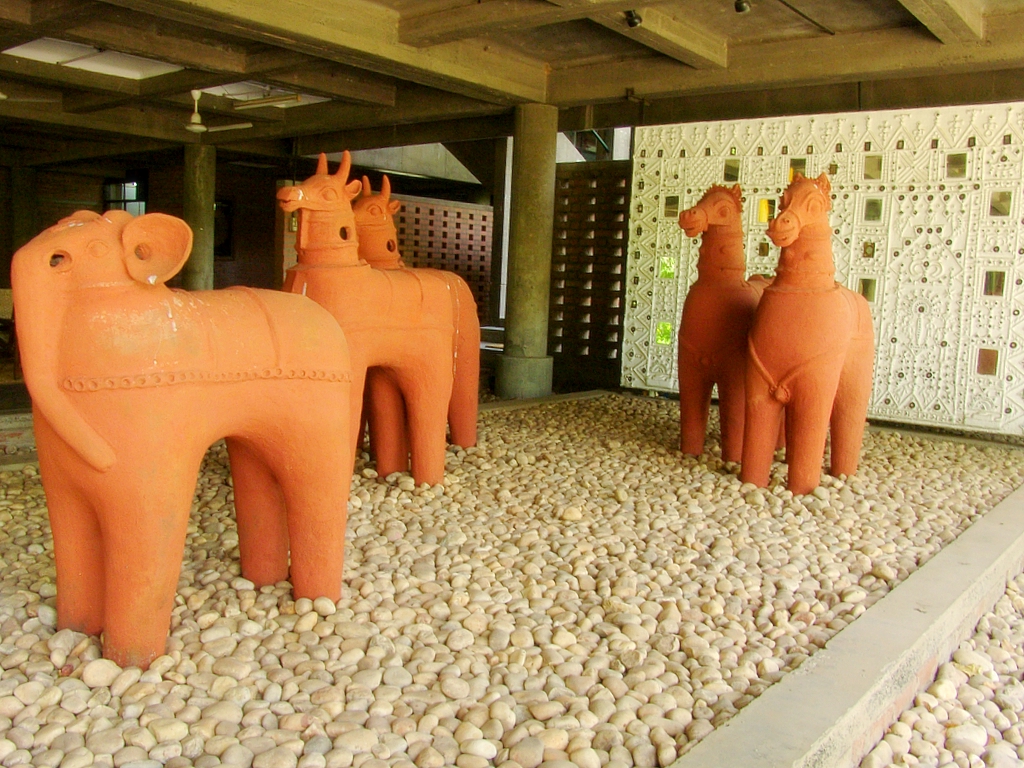
NID is the closest thing Gujarat has to a film school and it was never meant to be one. The Government of India invited Charles and Ray Eames to recommend a design programme for small industry, their India Report led to the institute in 1961, and the Sarabhais pulled in Frei Otto, Adrian Frutiger, John Cage, Robert Rauschenberg and Louis Kahn as collaborators through the 1950s and 1960s. The first Moog synthesisers in India arrived here, brought from New York by David Tudor. That is an unusually strange environment for a Gujarati village boy to walk into, which is exactly what happened next.
Pan Nalin was born Nalin Kumar Pandya in Adtala in Amreli district and sold tea with his father on the platform at Khijadiya Junction until he was twelve. He did a year of fine arts at M. S. University, then came to NID and paid for it by shooting about fifty wedding videos, bought old film cameras off the Sunday flea market in Ahmedabad, and made four animations and twenty short films before Samsara in 2001 collected a hundred and seventy rejections and then a Miramax release. Twenty years later he made Chhello Show, which India sent to the Oscars. Manish Saini studied in Ahmedabad, went to NID, borrowed money from relatives and friends to produce his own debut, and Dhh won the National Film Award for Best Feature Film in Gujarati at the 65th National Awards. Two National Award level Gujarati filmmakers, one design school, and no film school in the state at all.
Photo: Saad Akhtar, CC BY 2.0, via Wikimedia Commons.
6Faculty of Fine Arts, M. S. University of Baroda

Vadodara is called the cultural capital of Gujarat mostly because of this faculty. It came into being with the university in 1949 out of the old Baroda College, was built up under vice chancellor Hansa Mehta, and pulled in K. K. Hebbar, V. P. Karmarkar, Hermann Goetz, N. S. Bendre and K. G. Subramanyan at the start. By 1956 the Baroda Group was holding its first exhibition and the faculty had become shorthand for modernist practice in Indian art. Its original course list is the detail worth noting on a film and drama page: painting, sculpture, applied arts, art history, music, dance and architecture, all under one roof, at a moment when almost nowhere else in western India taught any of them at degree level.
Its place in the cinema story is smaller and specific. Pan Nalin, who disliked school and painted instead, left home young and did a year of fine arts here. He has described discovering world cinema in Vadodara, and then moved to NID in Ahmedabad. One year, no degree finished, and it is still the step where a boy from Amreli district stopped being a self taught painter and started being a filmmaker. For a state with no film school, the sequence of a year at Fine Arts in Baroda followed by design school in Ahmedabad is about as close to a national film school pathway as Gujarat has ever offered.
Photo: Gopinathkmyum1, CC BY-SA 4.0, via Wikimedia Commons.
7MICA

MICA is on this page because Gujarati screen work is not only made by directors and actors. Somebody writes the campaign, cuts the trailer, plans the release and buys the media, and in Ahmedabad the institution that professionalised that side is MICA. It was founded in 1991 by A. G. Krishnamurthy of Mudra Communications, an advertising man building a school for his own industry, and its first postgraduate communications batch started in 1994. The flagship remains the PGDM in Communications, with a doctoral fellow programme alongside it and partnerships running to Emory, Michigan State and Northwestern.
The detail that says most about the place is its current leadership. Jaya Deshmukh, appointed after Shailendra Raj Mehta's term ended on 31 May 2024, came out of the very first MICA batch and is the first woman to run the institute. A school founded in 1991 has now been around long enough that its own first year students are running it. For a Gujarati producer trying to open a film in a market where a bad first weekend kills a title, the communications talent pool in Ahmedabad is not a nice extra, it is the difference between a fifty week run and a two week one.
Photo: VISAVASU, CC BY-SA 4.0, via Wikimedia Commons.
8Faculty of Performing Arts, Parul University
Everything above this entry was built by a princely court, a literary institute, a physicist, a government department or an advertising agency. This one was built by a private university with fifty thousand students and an expansion strategy. Parul added a Faculty of Performing Arts with programmes in music, dance and drama, housed it in the same building as design and fine arts, and put it in Vadodara, the city with the deepest performing arts tradition in the state and the sharpest recent decline in working theatre groups. It also runs the Vadodara Film and Design Festival and the Maadhyam Media Fest, which is how a private university builds a scene rather than waiting for one.
Read it as a market signal rather than a heritage story. Gujarati cinema went from an industry the National Award jury refused to give a prize to for sixteen consecutive years, to one where a devotional drama made for a reported fifty lakh rupees returned a reported hundred and twenty crore. Careers in it are now plausible enough that a private university with no artistic history at all has decided a drama programme will fill seats. That is a different kind of validation from a Padma award, and for the next generation of Gujarati performers it may matter more.
Instagram: @paruluniversity (verified 2026-07-29).
9Gujarat University

Degrees have to be issued by somebody, and in Ahmedabad that somebody is usually Gujarat University. Established on 23 November 1949, it affiliates at undergraduate level and teaches at postgraduate level, which makes it the paperwork behind a large share of the city's arts, journalism and media qualifications. It is the least romantic entry on this page and the one that quietly determines whether a Gujarati student can study performance or media without leaving the state, because a course only exists in practice if a university will certify it.
The clearest example is the media pipeline. The National Institute of Mass Communication and Journalism opened in Bodakdev in 2007, is affiliated to Gujarat University, and awards BAJMC and MAJMC under it. It introduced radio journalism and digital media into media teaching in Gujarat, has been ranked repeatedly by Outlook India and India Today, and was the only media institute from the state to appear in OPEN Magazine's best colleges lists in 2022 and 2023. That institute is not given its own entry here because this site does not publish an entry it cannot illustrate with a verified image, and the honest thing is to say so rather than pad the list.
Photo: Gazal world, CC BY-SA 4.0, via Wikimedia Commons.
The three schools outside Gujarat that Gujarat keeps sending people to
None of these is in Gujarat. All three are load bearing for Gujarati cinema, which is the point.
10Film and Television Institute of India

FTII is the school Gujarat never built, and Gujarat has been using it since the 1970s. Ketan Mehta was born in Navsari in 1952, graduated in film direction from FTII, joined the Indian Space Research Organisation as a television producer with what he later called almost total freedom, travelled across Gujarat making programmes, and then made Bhavni Bhavai, a film about untouchability told through the Bhavai folk form, which took the National Film Award for Best Feature Film in Gujarati at the 28th ceremony. That is the full pipeline in one career: a Gujarati boy leaves the state to be trained, comes back to shoot in it, and produces the film that gives the industry a conscience.
The institute holds two other Gujarati careers of consequence. Satish Shah, whose father's family came from Mandvi, graduated in 1976 and in 1984 played fifty five different characters across fifty five episodes of Yeh Jo Hai Zindagi, which no Indian comic actor has repeated. Rita Bhaduri came out of the 1973 batch alongside Zarina Wahab. FTII also happens to be where a print of Kanku, Kantilal Rathod's 1969 adaptation of a Pannalal Patel story, survives, which is more than can be said for a great deal of Gujarati cinema of that decade. A film school in another state is currently doing Gujarat's archiving for it.
Photo: Bollywood Hungama, CC BY 3.0, via Wikimedia Commons.
11National School of Drama
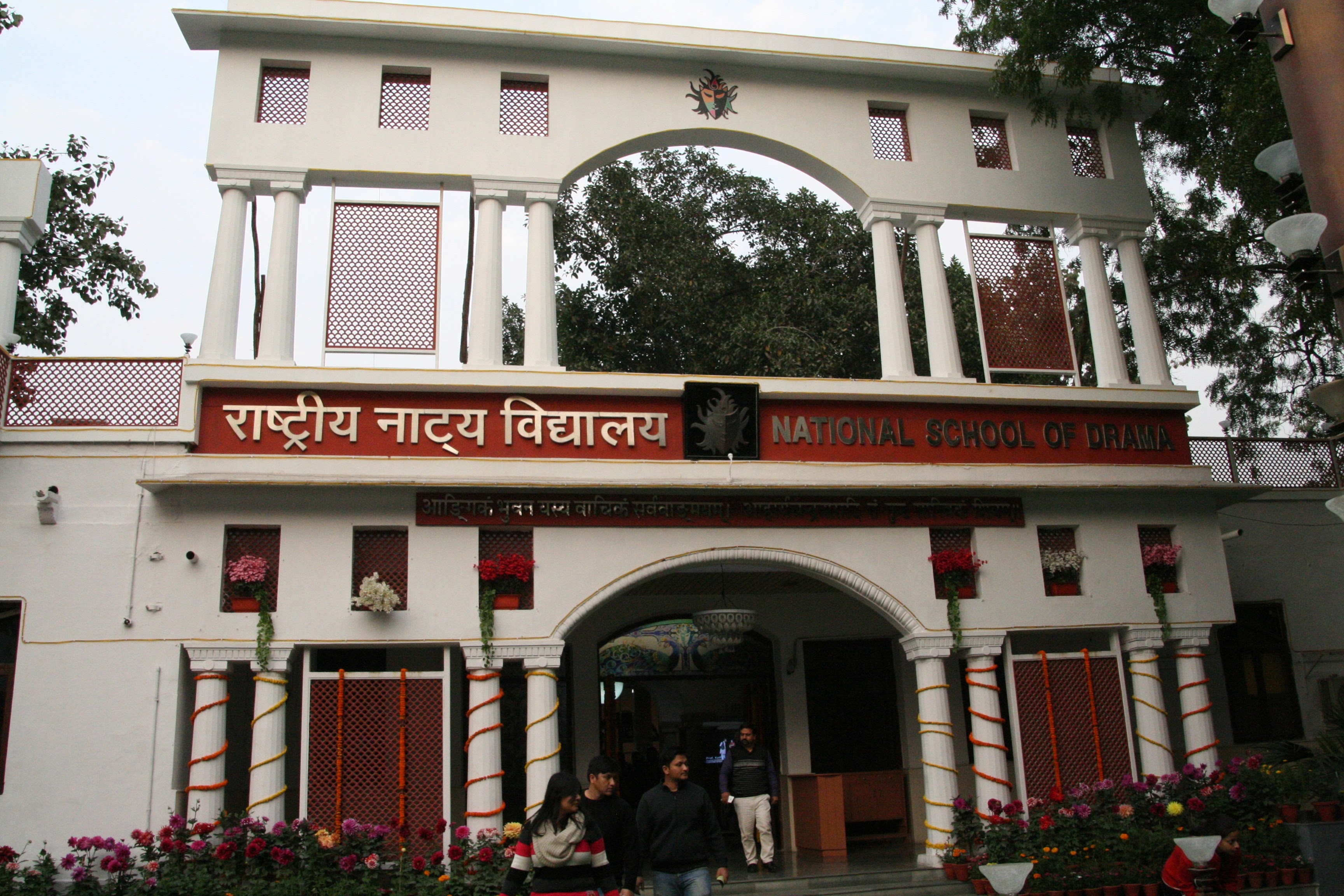
The NSD's Gujarati story has two halves that do not look like they belong to the same institution. On one side is the establishment route: Shanta Gandhi, an IPTA veteran and Dina Pathak's sister, chaired the school from 1982 to 1984, and Anang Desai came through as an alumnus and a member of the professional repertory before more than a hundred television shows and seventy films, including Babuji in Khichdi. On the other side, in 2006 and 2007, two young men from Chharanagar in Ahmedabad, Alok Gagdekar and Vivek Ghamande, got in out of a denotified tribe neighbourhood and a community theatre group founded to protest police killings.
Then there is the third case, which is the most Gujarati one of all. Paresh Rawal has no drama school on his record. He has a commerce degree and a Gujarati stage, more than two hundred and forty films and a National Award, and on 10 September 2020 the President of India appointed him chief of the National School of Drama. The institution he never attended handed him the keys. Read that against everything else on this page and it is the cleanest statement of how training actually works in this industry: the schools matter enormously, and the stage still outranks them.
Photo: Ramesh lalwani, CC BY-SA 4.0, via Wikimedia Commons.
12Whistling Woods International

The modern Gujarati film industry has a start date, and the person who supplied it went to this school. Abhishek Jain trained at Whistling Woods, assisted on Saawariya and Yuvvraaj in Mumbai, approached Anurag Kashyap to produce his Gujarati debut and got a no, and made Kevi Rite Jaish in 2012 with his brother Nayan producing instead. English Wikipedia credits that film with the revival of Gujarati cinema. Everything on this site dated after 2012, the box office growth, the multiplex slate, the National Awards, sits downstream of one Ahmedabad filmmaker who went to Mumbai for two years of training and then came back.
Ishaan Randeria is the second name, and the pairing is neat. He is the son of Siddharth Randeria, who has spent fifty years on the Gujarati stage and holds the record for the most live performances by a Gujarati actor. The son went to a Mumbai film school and directed his father's screen debut, Gujjubhai the Great, in 2015, when the father was fifty nine. One generation trained on stage in Gujarati, the next trained formally in film, and the second one filmed the first. That handover is the entire argument of this page in a single family.
Photo: Dr. Raju Kasambe, CC BY-SA 4.0, via Wikimedia Commons.
What the numbers say
Years running as of 2026, by institution
Counted from the founding years recorded by each institution or in English Wikipedia, run to 2026. Two entries on this page are deliberately absent from the chart: Natya Vidya Mandir, founded in Ahmedabad in 1949, because the record documents its troupe as active for twenty years and no current programme was verified, and the Faculty of Performing Arts at Parul University, which has no founding year on record. The M. S. University bar counts the full institutional line from the 1886 Academy of Indian Music, not the date the faculty took its present name.
Questions people actually ask
Is there a film school in Gujarat?
There is no central government film institute in Gujarat comparable to FTII in Pune. The closest thing is the National Institute of Design in Ahmedabad, set up in 1961, which trained Pan Nalin and Manish Saini, and design and communication schools such as MICA supply much of the rest. Gujarati filmmakers who want a dedicated film school usually go to FTII in Pune or Whistling Woods International in Mumbai.
Where can you study drama in Gujarat?
The two main options are the Faculty of Performing Arts at M. S. University of Baroda in Vadodara, which runs the state's oldest dramatics department and awards BPA and MPA degrees, and the Department of Drama at Gujarat Arts and Science College in Ahmedabad, which has taught drama since 1970 and awards a Bachelor of Arts in Theatre Arts. Parul University in Vadodara also runs a Faculty of Performing Arts with a drama programme.
Which school did Pan Nalin go to?
He did one year of fine arts at M. S. University in Baroda and then went to the National Institute of Design in Ahmedabad, funding it by shooting around fifty wedding videos. He bought old film cameras at Ahmedabad's Sunday flea market and made four animations and twenty short films before his first feature, Samsara, in 2001.
What was India's first theatre school?
Natya Vidya Mandir, established in Ahmedabad in 1949 by Gujarat Vidhya Sabha and led by Jaishankar Sundari, is recorded as the first theatre school in India, ten years before the National School of Drama was set up in Delhi. Its amateur troupe Natmandal was formed in 1951 to 1952 and remained active for twenty years.
Do you need a film school to work in Gujarati cinema?
No, and the counter examples are the biggest names in it. Paresh Rawal has a commerce degree and a Gujarati stage and was made chief of the National School of Drama in 2020. Siddharth Randeria learned in theatre from 1970. Pratik Gandhi is an industrial engineer who acted at night while employed at Reliance Infrastructure. Formal training helps most on the technical and directing side, which is where NID, FTII and Whistling Woods show up again and again.
Sources and image credits
All photographs are free-licensed files from Wikimedia Commons, reused with the attribution each licence requires. No press agency or studio photographs are hosted on this site. Instagram content is linked or embedded from the official account, never re-hosted.
- Official site of Gujarat Arts and Science College, Government of Gujarat, for the Department of Drama's founding year, course history and faculty, retrieved July 2026
- English Wikipedia articles on Maharaja Sayajirao University of Baroda, its Faculty of Fine Arts, National Institute of Design Ahmedabad, MICA, Parul University, Gujarat University, Gujarat College, National Institute of Mass Communication and Journalism, Natmandal, Darpana Academy of Performing Arts, Film and Television Institute of India, National School of Drama and Whistling Woods International, retrieved July 2026
- English Wikipedia biographies of Kirtidan Gadhvi, Pan Nalin, Manish Saini, Ketan Mehta, Satish Shah, Rita Bhaduri, Anang Desai, Paresh Rawal, Shanta Gandhi, Markand Bhatt, Mahesh Champaklal and Janak Dave, retrieved July 2026
- English Wikipedia article on Budhan Theatre for its National School of Drama admissions in 2006 and 2007
- Wikimedia Commons file pages for licence, photographer and date on every image used here
- Apify Instagram profile scrapes for account verification, run 29 July 2026