Across a verified credits database of 117 Gujarati films released between 2014 and 2026, three were directed by a woman, fourteen carry a woman in the writing credit and twenty one carry a woman in the producing credit. The three directed films are Hutututu: Aavi Ramat Ni Rutu (2016) and Duniyadari (2017), both by Shital Shah, and Dil Chemistry (2018) by Stuti Shukla. No woman has been credited as director on a film in that database since 2018. The women who do hold authorship in Gujarati cinema mostly hold it as producers: Manasi Parekh, who won the National Film Award for Best Actress at the 70th National Film Awards for Kutch Express, a film she produced; Twinkle Vijaygiri of Vijaygiri FilmOS; and Aarti Patel, who financed Love Ni Bhavai and Aum Mangalam Singlem.
Most lists about women in an industry are written as encouragement. This one is written as an audit. The question is narrow and structural: in Gujarati cinema, who actually gets to decide what a film is? Three jobs carry that decision. You direct it, you pay for it, or you write it. Everything else is execution of somebody else's choice, however brilliant the execution.
So we counted. The gujarati-cinema-credits database holds 117 unique features from 2014 to 2026 with verified credits pulled from IMDb. Every one of them lists a director. Three of those directors are women, and all three films came out before 2019. The producer column is where women actually appear, twenty one films of the 111 that carry producer data, and the writer column sits in between at fourteen of 104. That shape is the finding. In Gujarati cinema a woman is roughly seven times more likely to be the person who signs the cheque than the person who calls action.
The list at a glance
| Name | Authorship role | Key credits | Hardest credential |
|---|---|---|---|
| Shital Shah | Director and writer | Hutututu (2016), Duniyadari (2017), Saatam Aatham (2022) | Only woman among the 34 names in Wikipedia's list of Gujarati-language film directors |
| Fatma Begum | Director, producer, writer | Bulbul-e-Paristan (1926), Goddess of Luck (1929) | First woman to direct an Indian feature film |
| Manasi Parekh | Producer | Golkeri (2020), Kutch Express (2023), Jhamkudi (2024), Shubhchintak (2025) | Best Actress, 70th National Film Awards, for a film she produced |
| Twinkle Vijaygiri | Producer | Premji (2015), Montu Ni Bittu (2019), 21mu Tiffin (2021) | Financed two Raam Mori literary adaptations back to back |
| Aarti Patel | Producer and writer | Love Ni Bhavai (2017), Aum Mangalam Singlem (2022), Lagan Laagii Re (2026) | Backed the same writer-director unit across three features |
| Chandni Soni | Producer | Ittaa Kittaa (2024) | Moved Hindi streaming money into a Gujarati adoption drama |
| Falguni Patel | Producer and actor | Irada (2017), Ventilator (2018), Hirkani (2019), Umbarro (2025) | Financed Abhishek Shah's Umbarro, an ensemble carried by seven women |
| Nayanthara | Producer | Shubh Yatra (2023) | First Gujarati feature from Rowdy Pictures, her Tamil banner |
| Kaajal Oza Vaidya | Screenwriter and novelist | Saptapadii (2013), Dikri To Parki Thapan Kehvay, Moti Ba | More than 56 published books alongside 2,100 broadcast episodes |
| Prarthi Dholakia | Screenwriter | Montu Ni Bittu (2019), story and dialogue with Raam Mori | Shared a story credit with the most adapted writer in the language |
| Nehal Bakshi | Screenwriter | Love Ni Bhavai (2017), Aum Mangalam Singlem (2022), Lagan Laagii Re (2026) | Co-wrote the romance that ran past 100 days in Gujarati theatres |
| Antima Pawar | Screenwriter | Ittaa Kittaa (2024), Warso | First feature credit went straight to Prime Video |
| Kajal Mehta | Screenwriter and novelist | 53mu Panu (2022), Aagantuk (2023), Nasoor (2024), Fari Ek Vaar | Four screen credits in four years, all from her own fiction |
| Gohar Mamajiwala | Producer and studio co-owner | Ranjit Studios from 1929, more than 40 acting credits | Co-owned one of the largest studios in Indian cinema |
| Mallika Sarabhai | Producer, writer and performer | Darpana Communications, Women with Broken Wings (2012) | Around 3,000 hours of programming made for Doordarshan Gujarati |
How this list was built
Scope rule, stated plainly: a list of women who have directed Gujarati films would run to two verifiable names, and padding it with actresses would have been dishonest. So the page widens to the three authorship roles, direct, produce and write, and directors are placed first because that is the shortest section and the point. Everyone here has a verified credit on a Gujarati-language feature, telefilm or documentary, plus either a free-licensed Wikimedia Commons photograph or an Instagram account confirmed by scrape on 29 July 2026. People with real credits who could not clear that bar were dropped and are named here, because on this page the gaps are the story: Stuti Shukla, who directed Dil Chemistry in 2018 and is one of only two women in the database with a Gujarati directing credit; Shreyaa Shukla, who wrote and co-produced it; Hina Shah, who founded Limelight Pictures and produced Hutututu; Akanksha Tewari and Arya A. Menon, who produced Amdavad Ma Famous, winner of Best Non-Feature Film at the 63rd National Film Awards; Shreyanshi Patel of SP CineCorp, producer of Vickida No Varghodo; Smita Adhvaryu, writer of Kutumb; Shilpa Ganji, credited on Gujarat 11; Krupa Soni, producer of Hahacar; Deepali Mhaiskar, producer of Auntypreneur; Virginie Lacombe, a producer on Chhello Show. Meera Lakhia won Best Production Design at the 28th National Film Awards for Ketan Mehta's Bhavni Bhavai in 1980, the earliest National Award to a woman working on a Gujarati film, and is left out only because production design is craft rather than authorship. The thirteen actresses of Hellaro shared the Special Jury Award at the 66th National Film Awards, and are cited in the FAQ for the same reason. Sooni Taraporevala, filed by English Wikipedia under Gujarati-language film directors, is excluded because Little Zizou plays in Hindi and English. Names whose gender could not be confirmed, including two producers with real Gujarati credits, were left uncounted rather than guessed, which means every number here is a floor.
The directors
This is the first section and the smallest one, and that ordering is the argument.
1Shital Shah
Shital Shah wrote and directed Hutututu: Aavi Ramat Ni Rutu, which opened on 1 January 2016 and made her, in Femina's words that same week, one of the first women directors of the Gujarati film industry. She wrote it, directed it and acted in it. Duniyadari followed in 2017, again written and directed by her with co-writer Ankit Joshipura, a remake of the 2013 Marathi hit starring Malhar Thakar and Esha Kansara. Saatam Aatham came in 2022. Limelight's own awards page records Gujarat State Film Award recognition for Hutututu, second best director for her and second best film and best sound for the producer, Hina Shah.
The detail that matters more than any of those credits is the company name. Limelight Pictures was set up in 2015 by Hina Shah with her two daughters, Shital and Shaina, and Hutututu was its flagship. In other words, the woman who broke the director barrier in modern Gujarati cinema did it inside a production house her own mother built, financed by her own mother, with her sister in the cast. Nobody hired her. The family manufactured the job. Ten years on she is still the only woman on Wikipedia's list of 34 Gujarati-language film directors, and the database has recorded no woman directing a Gujarati feature since 2018.
Instagram: @shitalshahofficial (verified 2026-07-29).
2Fatma Begum

Fatma Begum came off the Urdu stage into Ardeshir Irani's silent Veer Abhimanyu in 1922 and became a star at a moment when men were still routinely playing women on screen. Four years later she stopped waiting. She founded Fatma Films in 1926, renamed it Victoria-Fatma Films in 1928, and directed Bulbul-e-Paristan the same year: a high-budget fantasy built on trick photography, with her daughters Sultana, Zubeida and Shehzadi in the cast. She kept writing, producing, directing and acting in her own pictures while taking paid roles at Kohinoor and Imperial. Her last film as director was Goddess of Luck in 1929. Her last screen credit was Diamond Queen in 1940. She had married Nawab Sidi Ibrahim Muhammad Yakut Khan III of Sachin State, the princely state that now sits inside south Gujarat, and when he objected to her working she divorced him and kept custody of her daughter.
English Wikipedia files her under film directors from Gujarat, which is why she opens this page rather than a Hindi one. What she really contributed is a template, and every woman further down this list is still using it. She did not get a directing job. She built a company so that the directing job existed. Ninety-nine years later, Shital Shah directs through a banner founded by her mother, Twinkle Vijaygiri produces through a banner she founded herself, and Aarti Patel produces the films she wants made. Ownership first, authorship second. In a century the sequence has not changed.
Photo: Uncredited studio still, public domain, via Wikimedia Commons.
The producers who sign the cheque
Twenty one of the 111 Gujarati films with producer data since 2014 have a woman in that credit. This is where the real authorship sits.
3Manasi Parekh

Look past the acting and the Soul Sutra slate reads like a commissioning strategy. Golkeri came first in 2020, a remake of the Marathi film Muramba, directed by Viral Shah and produced by Parekh with Parthiv Gohil, released on 28 February and then swallowed by the pandemic before it could finish its run. Kutch Express in 2023 was the social drama. Jhamkudi in 2024, written by Heath Bhatt and directed by Umang Vyas, was the horror comedy, and it was a commercial hit. Shubhchintak in 2025 was the crime thriller. Four films, five years, four different genres, and no two shot the same way.
That spread is the authorship. A producer with one hit usually orders the same film again, and Gujarati cinema in this stretch was busy cloning whatever worked last quarter. Parekh instead used the banner to test what the language could carry, and she used her own face as the underwriting on every one of them. The National Award for Best Actress at the 70th National Film Awards went to a performance she had personally financed the conditions for, which is a loop very few Indian actors have closed and almost nobody has closed in a regional language.
Photo: Bollywood Hungama, CC BY 3.0, via Wikimedia Commons.
4Twinkle Vijaygiri
The interesting decision a producer makes is not the budget, it is the source text. Vijaygiri FilmOS bought literature. Montu Ni Bittu, released 23 August 2019, took its story from Prarthi Dholakia and Raam Mori. 21mu Tiffin, released 10 December 2021, is adapted from a Raam Mori short story of the same name and follows a woman running a tiffin service. Before both of those came Premji: Rise of a Warrior in 2015, a period piece that Aarohi Patel's Wikipedia entry records as winning ten Gujarat State Awards including Best Film. Three features, and the through line is a producer who reads.
Set that against what the market was doing. Between 2019 and 2021 Gujarati cinema was chasing urban comedies and then horror, and the reliable way to raise money was to promise a young male lead in Ahmedabad. Buying short-story rights from a literary writer and then building a film around a middle-aged woman and her lunch boxes is a commissioning choice nobody was forcing on her. Vijaygiri also takes credit as painter and costume designer on her own films, which is one explanation for why they look more considered than the budgets should permit, and a second explanation for how the budgets stayed low enough to be approved.
Instagram: @twinklevijaygiri (verified 2026-07-29).
5Aarti Patel

Line the three films up and the same names keep appearing. Love Ni Bhavai in 2017: directed by Saandeep Patel, written by Mitai Shukla and Nehal Bakshi, produced by Aarti Patel. Aum Mangalam Singlem in 2022: same director, same two writers, same producer. Lagan Laagii Re in 2026: same director, same two writers, with Patel as co-producer alongside Rashmin Majithia. Gujarati cinema mostly assembles a new crew per project, because that is what one-film financing forces. Patel has instead kept a single authorship unit fed for nine years, which is the closest thing the industry has to a house style built on purpose.
Her own Instagram bio lists the order she sees it in: writer, storyteller, actress, producer. Two of the three films are romances, financed by a woman, in a market that in 2017 was still being sold to distributors as comedy-only. Both worked. What that continuity actually bought is a writing pair with a track record, which is the scarcest asset in a young industry and the one thing a single hit can never create on its own.
Photo: Priyank Vyas, CC BY-SA 4.0, via Wikimedia Commons.
6Chandni Soni
Chandni Soni's money did not come from Gujarati cinema. It came from Hindi streaming, from Raktanchal and its sequel on MX Player and from Tandoor, the kind of gritty crime slate that has nothing to do with a family drama in Ahmedabad. In 2024 she put it into Ittaa Kittaa, directed by Abhinn Sharma and Manthan Purohit, written by Antima Pawar and Azhar Saiyed, starring Manasi Parekh and Raunaq Kamdar, and built around a married couple adopting two girls. The film went to Prime Video and to ShemarooMe.
Read the chain of decisions on that one film and you have the whole thesis of this page. A woman with outside capital greenlit a script co-written by a woman making her first Gujarati feature, on a subject, adoption, that no commercial pitch deck in this industry would have led with. Change any link in that chain and the film does not exist. Soni is one of the very few producers in Gujarati cinema who arrived with capital earned elsewhere rather than inherited locally, and it is not a coincidence that the film she chose looks nothing like the market around it.
Instagram: @chandniso (verified 2026-07-29).
7Falguni Patel
Falguni Patel finances films that have no single hero to sell. Ventilator in 2018, directed by Umang Vyas from a Niren Bhatt and Karan Vyas script, is a dysfunctional Gujarati family spread across an ICU corridor, with Jackie Shroff and Pratik Gandhi inside an ensemble rather than above it. Umbarro in 2025, her fourth production and Abhishek Shah's first Gujarati feature after Hellaro, is a remake of the Marathi film Jhimma and runs on Vandana Pathak, Kaajal Oza Vaidya, Suchita Trivedi, Deeksha Joshi, Tarjanee Bhadla, Tejal Panchasara and Vineeta Joshee. News India Times, covering the film's United States premiere, lists her four titles and notes that she acts as well.
Ensembles are the hardest thing to finance in a small industry because there is no face for the poster and no name for the distributor to price against. That is precisely the category Patel has funded twice, once at the start of the 100-crore era and once well into it. Umbarro also answers a question the Hellaro conversation left hanging: the National Award winning film about a group of women in the Rann had a male director and an all-male producing line. The follow-up, seven women on screen, was co-financed by one.
Instagram: @falu_c_patel (verified 2026-07-29).
8Nayanthara

In 2023 Rowdy Pictures, the banner Nayanthara runs with Vignesh Shivan, produced Shubh Yatra, a remake of the Tamil film Aandavan Kattalai directed by Manish Saini and starring Malhar Thakar, Monal Gajjar and Darshan Jariwala. English Wikipedia records it as the pair's first ever Gujarati film. Nayanthara has more than 75 films behind her across Tamil, Telugu and Malayalam, five Filmfare Awards South, and was the only South Indian actress in Forbes India's Celebrity 100 list in 2018. None of that had anything to do with Gujarat until she decided it did.
Include her here for what the cheque signals rather than for a body of Gujarati work she does not have. When a star-owned production house from another language crosses over, it is not patronage, it is a read on the market: somebody ran the numbers on Gujarati theatrical and liked them. Shubh Yatra also came in the middle of a run where three of the biggest cross-language bets on Gujarati cinema were placed by women producers, alongside Chandni Soni's Ittaa Kittaa and the Panorama Studios money behind Maharani. That is a shift in where the industry's outside capital is coming from, and it has gone almost entirely unremarked.
Photo: Bollywood Hungama, CC BY 3.0, via Wikimedia Commons.
The writers
Fourteen of the 104 Gujarati films with writer data since 2014 carry a woman in the credit. Five of those women clear the verification bar.
9Kaajal Oza Vaidya

Kaajal Oza Vaidya is the most widely read living writer in the Gujarati language and her screen career is almost entirely television. She wrote story, screenplay and dialogue for three Gujarati telefilms, Antarna Ujas, Sukhno Arth and Hu Ja Bhagyavidhata. Ek Daalna Pankhi ran to 1,600 episodes on DD Girnar from 2001. Moti Ba ran 500 on ETV Gujarati. In Hindi she wrote Apne Paraye for B4U and Mahasati Savitri for SAB TV. Her feature screenplays are Dikri To Parki Thapan Kehvay and Saptapadii in 2013, plus the Hindi films Ghat and Diwanagi. She also teaches creative writing as visiting faculty at Gujarat University and hosts a radio show in Ahmedabad.
That imbalance is worth stating without decoration. A revival-era film industry sat in the same city as a writer with 56 published books and 2,100 broadcast episodes of proven audience command, and used her for two features in two decades. When Gujarati cinema finally put her on a set in the 2020s it was as an actor: Karkhanu in 2024, then Umbarro and Taaro Thayo in 2025. The industry found room for her face before it found room for her pen, which tells you which of the two it considers scarce.
Photo: Sunnyvaghela1987, CC BY-SA 4.0, via Wikimedia Commons.
10Prarthi Dholakia

One feature credit, and it is a serious one. English Wikipedia records the story of Montu Ni Bittu as written by Prarthi Dholakia and Raam Mori, which puts her name beside the single most adapted literary voice in Gujarati cinema on a film that Vijaygiri Bava directed and Twinkle Vijaygiri produced. The film, a comedy about two childhood friends starring Maulik Nayak and Aarohi Patel, opened on 23 August 2019 and went on to collect a run of awards on the Gujarati festival circuit.
Here is the part that reads like a diagnostic rather than a biography. Dholakia has four freely licensed photographs of her on Wikimedia Commons, more than almost anyone else in this database, several of them uploaded around the time the film was in production. She has one feature credit. Plenty of male screenwriters in the same credits table have five, six, ten. The bottleneck in Gujarati screenwriting has never been visibility or willingness. It is the second commission, and for women it mostly does not arrive.
Photo: Chintak23, CC BY-SA 4.0, via Wikimedia Commons.
11Nehal Bakshi
Love Ni Bhavai arrived in 2017 with a Sachin-Jigar score and Niren Bhatt lyrics, and it did the thing Gujarati cinema had not managed on this scale before: it made a straight romance work theatrically, running long enough for Ahmedabad Times to publish a note marking 100 days. Wikipedia credits the screenplay to Mitai Shukla and Nehal Bakshi. The same pair wrote Aum Mangalam Singlem in 2022 and Lagan Laagii Re in 2026, all three directed by Saandeep Patel, all three with Aarti Patel on the producing line.
Nine years with the same collaborators is unusual anywhere and extremely unusual here, where writers typically get one film and then vanish back into advertising or television. What Bakshi has that most women in the writer column do not is the second and third commission, and the reason is visible in the credits: the producer who backed the first film kept backing the team. Her Instagram identifies her work as poetry, screen and voice, in that order, which is a fair description of a Gujarati screenwriting career even at its most successful.
Instagram: @olivechashma (verified 2026-07-29).
12Antima Pawar
Antima Pawar's first Gujarati feature credit is a family drama about a married couple adopting two girls, co-written with Azhar Saiyed and directed by Abhinn Sharma and Manthan Purohit. Ittaa Kittaa released in February 2024 with Manasi Parekh and Raunaq Kamdar leading and Chandni Soni, Pankaj Keshruwala and Vikas Agarwal producing. It went to Prime Video. Her other credit, Warso, streams on ShemarooMe.
Adoption is not a subject the Gujarati box office has any data on, which is exactly why a debut screenwriter would normally be told to write something safer. The film got made because the producing line was willing to carry an untested premise, and the fastest read on this whole page is that the two Gujarati features here with a woman writer on an untested subject, Ittaa Kittaa and 21mu Tiffin, both had a woman in the producer credit as well. The writing pipeline and the financing pipeline are not two separate problems. They are one problem, and it clears from the money end first.
Instagram: @pawar_antima (verified 2026-07-29).
13Kajal Mehta
Kajal Mehta writes novels in English, gets them published in Gujarati by R R Sheth, and then adapts them. 53mu Panu, released in July 2022, is built on her story. Aagantuk followed in 2023, co-written with director Naitik Raval. Nasoor came in 2024 with Rishil Joshi directing. Fari Ek Vaar rounds out a filmography of four in roughly four years, all of it in the small-budget lane rather than the festival or franchise lanes.
The two-step is the point. A male screenwriter in this industry writes a script and pitches it. Mehta writes a book, gets it published, builds a readership, and then the film conversation becomes possible. That is a longer and more expensive road to the same room, and she has walked it four times. It also produces a specific kind of output, since a script that started as a novel arrives with its structure already stress-tested by readers, which is one reason her titles keep getting made in a segment where most first drafts do not.
Instagram: @kajal_mehta_me (verified 2026-07-29).
The ones who owned the building
Two women who did not ask an industry for permission, one in 1929 and one still working in Ahmedabad.
14Gohar Mamajiwala
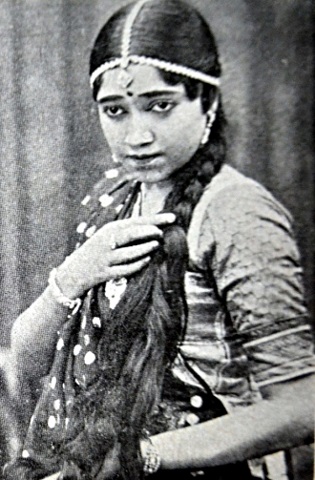
Gohar Khayyam Mamajiwala, billed as Miss Gohar, was pushed into acting at sixteen because her father's business was failing and a family friend, the director Homi Master, suggested it. Her debut, Baap Kamai in 1926, was directed by Kanjibhai Rathod for Kohinoor Films and it was a hit. She then did something almost nobody in Indian cinema had done and no woman had: she went into ownership. With Jagdish Pasta, Chandulal Shah, Raja Sandow and the cameraman Pandurang Naik she started Shree Sound Studios, and in 1929, with Chandulal Shah, she founded Ranjit Studios, later Ranjit Movietone, which grew into one of the largest and longest running studios in the country. English Wikipedia lists her not as an actress who invested but as a studio co-owner.
Scan her filmography and the titles keep coming back to the same well: Lanka Ni Laadi, Lakho Vanjaro, Sati Jasama, Ra Kawat, and Gunsundari made twice, in 1927 and again in 1934. That is Gujarati folklore, made in Bombay, before a Gujarati-language film industry properly existed. She retired in the 1970s and died in Bombay in 1985. She belongs on this page because she is the earliest proof of the pattern: in this part of the film business a woman's route to deciding what gets made has run through the deed to the studio, not through a job title.
Photo: Uncredited studio still from My Darling (1930), public domain, via Wikimedia Commons.
15Mallika Sarabhai

Run the numbers on total screen output by a woman in Gujarat and Mallika Sarabhai is not close to second. Through Darpana Communications she has been responsible for producing roughly three thousand hours of broadcast programming, all of it carried on Doordarshan Gujarati, spanning the NACO series on HIV, the science series Turning Point, the culture quiz Vaividhyotsav and the environment quiz Srishti. She writes her own material: her shows, television serials for ISRO's educational broadcasting in Madhya Pradesh, film scripts, and the script for Unsuni, drawn from Harsh Mander's book, which travelled to 120 schools and colleges. In 2012 she co-directed Women with Broken Wings with the filmmaker Yadavan Chandran and the Swiss pianist Elizabeth Sombart, and in 2014 the two of them made Kadak Badshaahi, a multimedia history of Ahmedabad that ran 33 straight nights at Darpana's Natarani.
Almost none of that is cinema, and that is the observation worth ending on. The single largest screen production operation ever run by a woman in Gujarat routed itself into television, stage and behaviour-change programming rather than into features. Whether that was a choice or a closed door, the effect is the same: the state's most complete example of a woman holding final cut built it entirely outside the film industry that sits in the same city. Her one Gujarati film credit remains Mena Gurjari, from 1975, as an actor.
Photo: Dr. Chinchu C., CC BY-SA 4.0, via Wikimedia Commons.
What the numbers say
Gujarati films with a woman in each authorship credit, 2014 to 2026
Counted by hand from an IMDb-sourced credits database of 117 unique Gujarati features released between 2014 and 2026. Every film in it carries a director credit, 104 carry writer credits and 111 carry producer credits. Any name whose gender could not be confirmed was left uncounted, so these three figures are floors rather than ceilings.
Questions people actually ask
Who was the first woman to direct a Gujarati film?
Shital Shah is the name the modern record supports. Her debut Hutututu: Aavi Ramat Ni Rutu opened on 1 January 2016 and Femina described her that week as one of the first women directors of the Gujarati film industry. She remains the only woman among the 34 names in English Wikipedia's list of Gujarati-language film directors. India's first woman film director overall was Fatma Begum, who directed Bulbul-e-Paristan in 1926.
How many Gujarati films have been directed by women?
Three, in a verified credits database of 117 features released between 2014 and 2026. They are Hutututu: Aavi Ramat Ni Rutu (2016) and Duniyadari (2017), both directed by Shital Shah, and Dil Chemistry (2018), directed by Stuti Shukla. That database records no Gujarati feature directed by a woman since 2018.
Which Gujarati films were produced by women?
Twenty one of the 111 films with producer data, which makes producing by far the most open of the three authorship roles. The list includes Kutch Express, Jhamkudi and Golkeri (Manasi Parekh), Love Ni Bhavai and Aum Mangalam Singlem (Aarti Patel), Montu Ni Bittu and 21mu Tiffin (Twinkle Vijaygiri), Ittaa Kittaa (Chandni Soni), Ventilator and Umbarro (Falguni Patel), Shubh Yatra (Nayanthara), Vickida No Varghodo (Shreyanshi Patel) and Amdavad Ma Famous (Akanksha Tewari and Arya A. Menon).
Has a woman won a National Film Award in Gujarati cinema?
Several have. Meera Lakhia won Best Production Design at the 28th National Film Awards for Ketan Mehta's Bhavni Bhavai in 1980. Akanksha Tewari and Arya A. Menon produced Amdavad Ma Famous, which took Best Non-Feature Film at the 63rd. The thirteen actresses of Hellaro shared the Special Jury Award at the 66th, the same ceremony where the film became the first Gujarati title to win Best Feature Film. Manasi Parekh won Best Actress at the 70th for Kutch Express, a film her own banner produced.
Why are there so few women directors in Gujarati cinema?
The pattern in the credits is ownership, not hiring. Almost every woman who has authored a Gujarati film did it from inside a company she or her family controlled. Shital Shah directed through Limelight Pictures, founded by her mother Hina Shah. Twinkle Vijaygiri produces the films her partner Vijaygiri Bava directs, through the banner she runs. Aarti Patel produces the writer-director team she has backed since 2017. Fatma Begum founded Fatma Films in 1926 specifically so she could direct her own script. Nobody in this list was simply offered the job, which is why the producer column has seven times the representation of the director column.
Sources and image credits
All photographs are free-licensed files from Wikimedia Commons, reused with the attribution each licence requires. No press agency or studio photographs are hosted on this site. Instagram content is linked or embedded from the official account, never re-hosted.
- English Wikipedia biographies and film articles, retrieved July 2026
- IMDb-sourced Gujarati cinema credits database covering 117 unique features, 2014 to 2026, verified April 2026
- Wikimedia Commons file metadata for photographer, licence and description, retrieved July 2026
- Instagram account details confirmed by scrape, 29 July 2026
- National Film Awards records for the 28th, 63rd, 66th and 70th ceremonies as cited on English Wikipedia
- Limelight Pictures company and awards pages for the Hutututu production and award record
- News India Times reporting on the United States premiere of Umbarro, February 2025
- Femina, January 2016, on Shital Shah and the release of Hutututu